Dubrovnik

Dubrovnik City Walls Walking Route

The route at a glance

  1. 1 Pile Gate wall entrance start — immediately south of the outer Pile Gate
  2. 2 Fort Bokar 5 min walk south-west along the wall from Pile Gate
  3. 3 South wall — sea-facing stretch 10 min walk east along the south wall
  4. 4 St. John Fortress (Tvrđava Sv. Ivana) 15 min walk east from south wall mid-point
  5. 5 Revelin Fortress 5 min walk north — east end of wall circuit
  6. 6 North wall — city view back toward Pile 10 min walk west along the north wall
  7. 7 Minčeta Tower 15 min walk west — north-west corner
  8. 8 Return to Pile Gate 10 min walk south-west — completion of circuit

The view you buy with a ticket

There are many ways to see Dubrovnik. The Stradun gives you the city at street level — magnificent, crowded, entirely flat. The cable car gives you the panorama from 412 metres above — Mount Srđ, the whole coastal shelf, the islands. The city walls give you something neither of those can: the city from the height of its own fortifications, moving through it rather than watching it from a distance.

The circuit is approximately two kilometres. The walls are genuine medieval fortifications — not a reconstruction, not a promenade path bolted onto a historic site, but the actual defensive structure of the Republic of Ragusa, built over several centuries to keep this city independent. The Republic stayed free for over four hundred years. Walking the walls is a way of understanding why: the height, the sea visibility, the overlapping arcs of fire between towers, the sheer mass of stone. The defensive logic is readable on foot in a way it never is from a guidebook.

What the circuit gives you

Anticlockwise from Pile Gate: south along the sea wall with the Adriatic directly below, around the south-east corner at St. John Fortress where the harbour opens, east to Revelin, then the long return along the north wall with the entire interior of the old town spread out below you, climbing to Minčeta Tower at the north-west high point before descending back to Pile.

Two hours is the right budget on a spring or autumn morning. In high summer, between 10am and 3pm, the same circuit takes longer and costs more in physical effort than the ticket price suggests. The stone is pale and baked and reflects heat from all sides. There is no shade anywhere on the circuit.

Go early. Buy water before you climb. The views — the south wall sea drop, the old town grid from the north parapet, the sweep of coastline from Minčeta — are exactly as good as they look in photographs. Better, in better light, earlier in the day.

start — immediately south of the outer Pile Gate

Pile Gate wall entrance

The ticket booth sits just inside the outer Pile Gate, at the base of the staircase that leads up onto the wall walkway. This is the main entry point for most visitors and the natural starting position if you have walked in from the Stradun.

Buy your ticket here before climbing. The gate below you — actually two gates in sequence, the outer 15th-century arch and a smaller inner one — was the principal western entrance to the Republic of Ragusa for centuries. The stone bridge approaching it crosses what was once a moat. The outer arch is Gothic; the inner gate carries a relief of St. Blaise, Dubrovnik's patron saint, a figure you will see repeated on buildings throughout the old town.

At the top of the staircase the wall walkway opens in both directions. The circuit is conventionally walked anticlockwise — starting right, heading toward Fort Bokar and then south — which puts the open sea views on your left early and brings Minčeta Tower as the high point in the second half. Either direction works; this route follows the anticlockwise convention.
5 min walk south-west along the wall from Pile Gate

Fort Bokar

Fort Bokar sits at the south-western corner of the walls, a two-storey casemate fortress built between 1461 and 1463 to defend the seaward approach and the Pile Gate from the south. It is the oldest example of a circular artillery fortress in the Adriatic — a design that spread through Renaissance military architecture precisely because it deflected cannon fire more effectively than square towers.

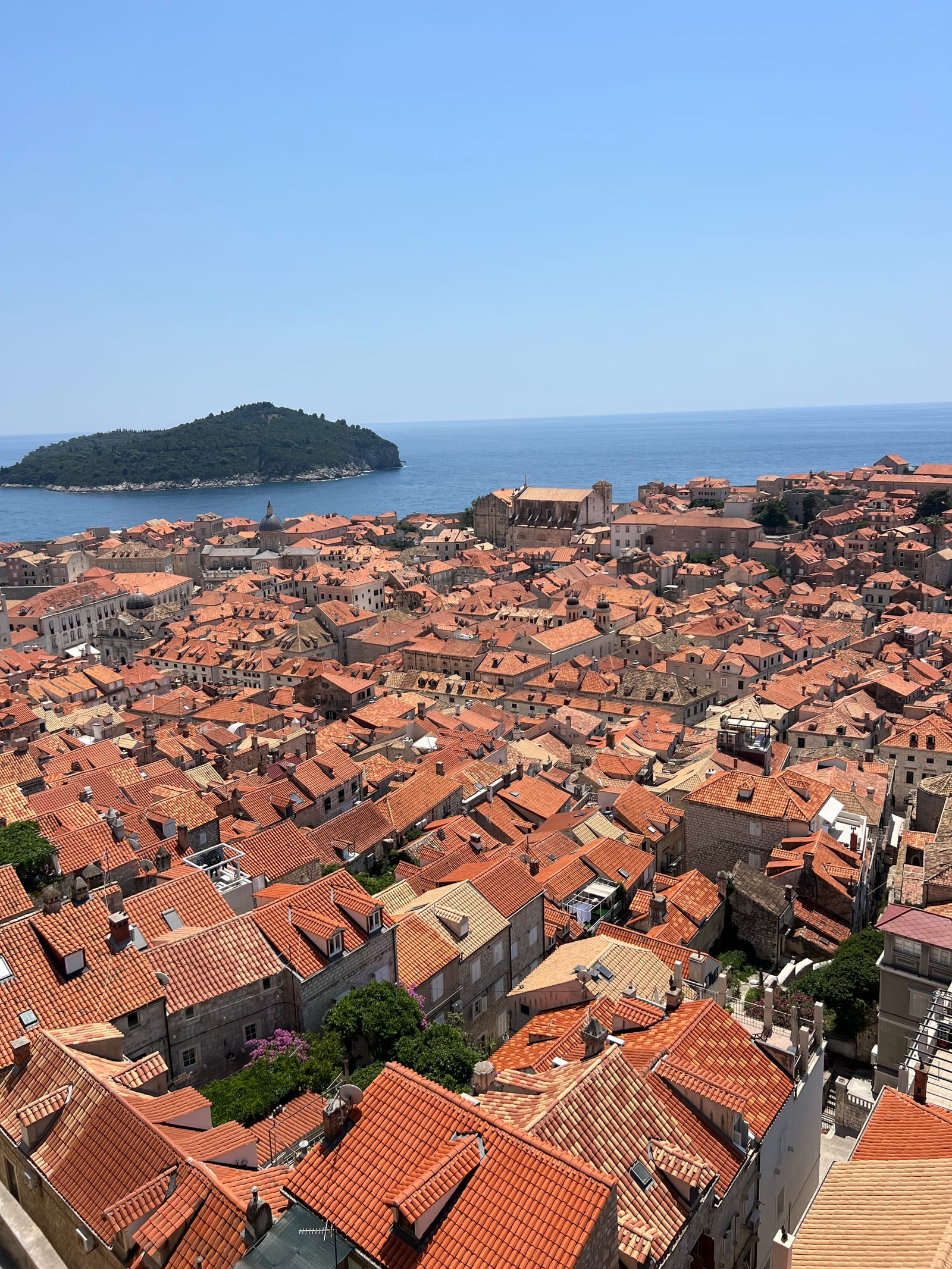
From the walkway above Bokar, the view opens directly down to the sea: the water is visible below the cliff face, with the island of Lokrum in the near distance and the open Adriatic beyond. On Game of Thrones, the waterfront below this stretch of wall featured in Blackwater Bay sequences — the same water, the same cliff, the same stone. The fort itself is used seasonally as a concert and events venue.

Continuing along the south wall, the walkway narrows and the views become more exposed. The Adriatic is directly below you on the left; the old town rooftops, the cathedral dome, and the tightly packed buildings are visible on the right. In the early morning this section catches the best light.

North wall section — old town below, Adriatic beyond

10 min walk east along the south wall

South wall — sea-facing stretch

The south-facing section of the wall runs roughly seven hundred metres from Fort Bokar to St. John Fortress and Fort Revelin, with the sea on your left and the old town below you on the right. This is the most consistently dramatic section of the circuit: the walls here are built directly on the cliff edge, and the Adriatic is visible the entire length of the walk.

The walls reach a maximum height of around 25 metres at their highest points — that measurement is taken from outside at the base; the actual drop visible from the walkway depends on where you are standing and what lies below. At certain points you are looking down a long, nearly vertical face of pale limestone directly to the water. On a calm day in spring, the colour of the sea below is genuinely extraordinary.

Keep an eye on the opposite side: the old town rooftops from this angle give you an urban geography lesson. The grid of streets, the cathedral dome, the bell tower above the Stradun, the orange-tiled rooftops rebuilt uniformly after the 1667 earthquake — it reads as a plan view of a functioning medieval city.

15 min walk east from south wall mid-point

St. John Fortress (Tvrđava Sv. Ivana)

St. John Fortress anchors the south-east corner of the walls, controlling the entrance to the old harbour. Its primary purpose was exactly that: the fortress and its chain boom across the harbour mouth prevented enemy ships from entering. The current structure was built in the 16th century, with later additions; the design is L-shaped, with a round tower facing the sea and a rectangular section defending the harbour entrance from the landward side.

Today the lower levels house the Aquarium and the Maritime Museum — both accessible from ground level inside the old town, not from the walls. From the wall walkway above, the view south-east takes in the old harbour directly below: small fishing boats, the jetty for Lokrum Island ferries, and the outer breakwater. On a clear day the coastline stretches toward Cavtat and the Montenegrin border.

The harbour itself is one of the most painted and photographed spots in Dubrovnik — the combination of the fortress tower, the breakwater, and the Adriatic behind it is immediately recognisable. From the wall, you have it directly beneath you.

5 min walk north — east end of wall circuit

Revelin Fortress

Revelin is the detached fortress guarding the Ploče Gate at the eastern end of the old town — the entrance that faces away from the sea toward the landward approaches. Construction ran from 1538 to 1549, funded at great expense and built outside the main wall circuit because the city's eastern approach had no natural sea defence. It became the strongest single fortification in the system.

The Republic of Ragusa used Revelin as a treasury and refuge during periods of crisis: during the great earthquake of 1667, which destroyed much of the old town, the city's silver and gold was stored here. Today it operates as an events venue (the summer club night there is one of the more unusual repurposings of a 16th-century fortress anywhere).

From the Revelin section of the wall circuit, the view east and north gives you a completely different picture from the sea-facing south wall: the green hills above Ploče Gate, the road heading toward the Dalmatian interior, and the outer suburbs of Dubrovnik visible in the distance. This is the land side — the direction the Republic was always most worried about.

East wall looking back toward Minčeta
North wall, approaching the high point

Mid-circuit — the city from above

10 min walk west along the north wall

North wall — city view back toward Pile

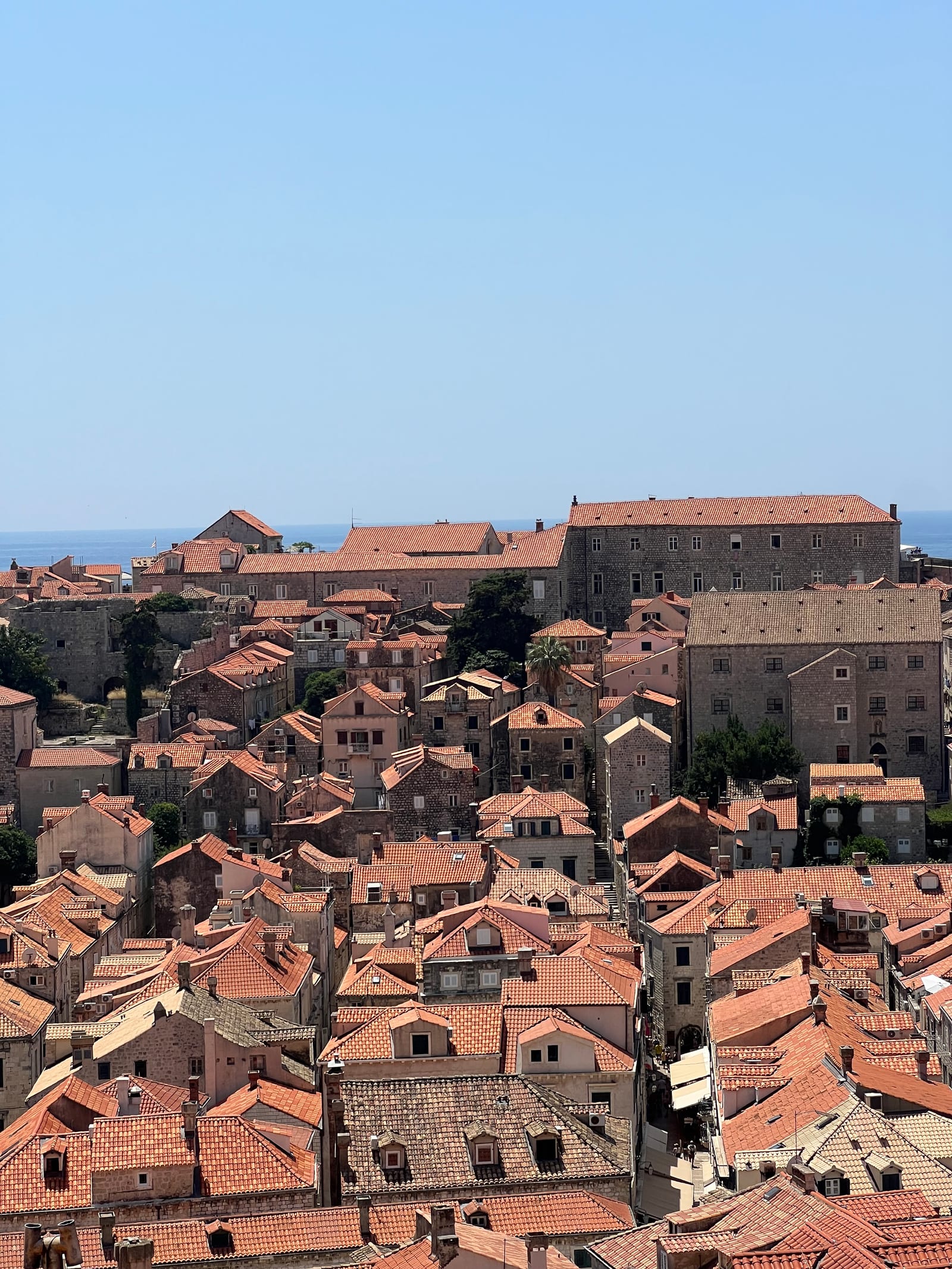
The north wall runs the length of the old town back toward Pile Gate, with the city below on your left and the hillside above the walls on your right. This is the section with the most consistently useful urban views: from here you see the entire interior of the old town laid out as a compressed rectangle — every street, every square, every church tower.

The Franciscan Monastery is directly below this section of the wall, its cloister roof visible from above. The Stradun itself is legible as the main east-west axis. The tower of the Dominican Monastery marks the north-east corner. Looking west from the mid-point of the north wall, you begin to see Minčeta Tower rising above the line — the round fortress that marks the highest point of the circuit, still ahead on the north-west corner.

On the right side of the walkway (outside the walls), the hillside vegetation and the buildings climbing the slope above the fortifications give a sense of the topography that the flat Stradun conceals. Dubrovnik is not flat: the old town is built on a narrow coastal shelf, and everything behind it rises steeply.

15 min walk west — north-west corner

Minčeta Tower

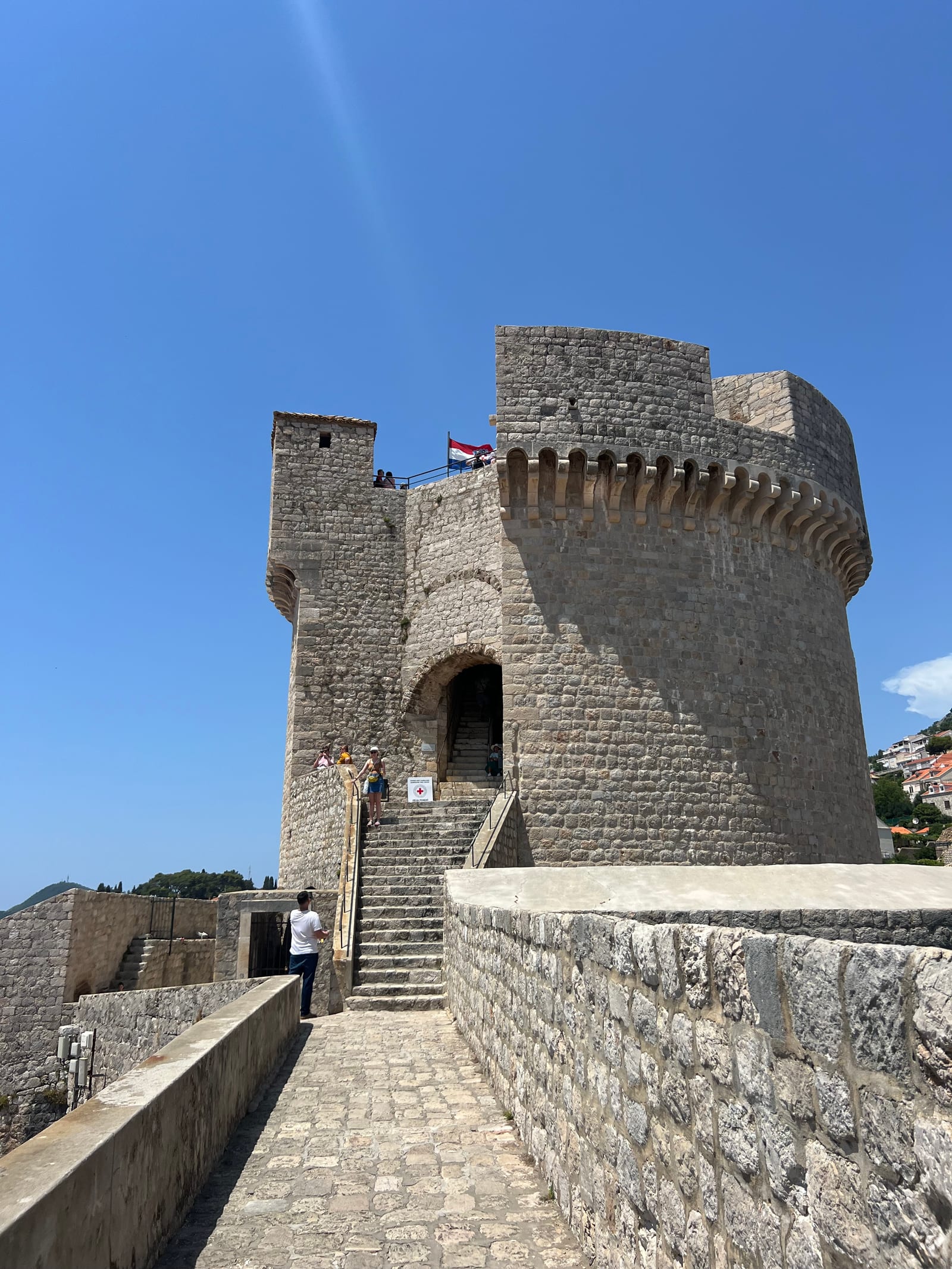
Minčeta Tower is the highest point on the city walls and the most visually dominant element of the northern fortification. The round keep was begun in the 1330s under Dubrovnik architect Niculinius and completed in its current form in 1464 by Juraj Dalmatinac — the same architect responsible for the Cathedral of St. James in Šibenik. It is widely considered the symbol of Dubrovnik's defences and its unconquerable character.

From the top of the tower the view north and west is the most expansive on the circuit: the hills above the city, the Adriatic visible in the distance, and the full sweep of the northern walls curving from where you stand back to Pile Gate. Inside the tower the circular staircase winds up through the thick walls to the open crown platform, where the drop over the parapet gives you Dubrovnik's northern skyline at eye level.

Game of Thrones used the exterior of Minčeta Tower as the visual reference for the House of the Undying — the location in Qarth in season two where Daenerys seeks her dragons. The tower's profile, seen from outside the walls, has a distinctive silhouette that made it recognisable to viewers who had no idea it was in Croatia.

Minčeta section — the northwest corner

10 min walk south-west — completion of circuit

Return to Pile Gate

From Minčeta the wall descends back south-west toward Pile Gate, completing the anticlockwise loop. The staircase drops back down to the ticket entrance level, and the gate arch ahead marks the end of the circuit.

As you descend, look back once from the last elevated section: the Stradun is visible below, the Franciscan Monastery on one side, the buildings of the south wall on the other, and the campanile bell tower marking the far end of the main street. The full geometry of the old town — which the walls gave you piece by piece for the last two hours — is visible as a single image.

Exit through Pile Gate and you are back at the outer arch, the stone bridge, and the moat. The Stradun is immediately to the right. Most people head for the Onofrio Fountain on the left — the large circular fountain just inside the gate, built in 1438 as part of Dubrovnik's aqueduct system — which is also the starting point for the old town self-guided walk.

Practical tips

Frequently asked questions

How much does it cost to walk the Dubrovnik city walls?

Around €35–40 as of 2026, though prices have risen steadily in recent years — check the current rate at the ticket booth on the day. Tickets are sold at the Pile Gate (west, main entrance) and the Ploče Gate (east). The fee covers one full circuit; you cannot re-enter if you leave the walls.

How long does the Dubrovnik walls walk take?

Around two hours at a relaxed pace with photo stops. Fit walkers who keep moving can do the circuit in ninety minutes; in high season with crowds bottlenecking at the towers, it can stretch to two and a half hours. Budget two hours and do not rush — the walls are the reason you came.

What are the opening hours for the Dubrovnik city walls?

9am to 5pm in winter; extended to 7pm from May through mid-October (approximate — check on the day as hours can vary by season and year). Do not start late in the day: the circuit takes two hours, and finishing in dimming light on a narrow parapet is not comfortable.

Is the walls walk suitable for children?

Older children (roughly 8 and above) who are comfortable with heights and sustained stair-climbing can manage the circuit. The exposed parapets at height and the narrow sections near the towers require attention. Very young children are not suitable — there are no handrails in places, and the drop is real. Strollers cannot do the route.

Where do you enter the Dubrovnik city walls?

The main entrance is near the Pile Gate at the western end of the Stradun — the obvious start if you are arriving from the west or from the bus terminus. There is a second entrance near the Ploče Gate at the east end. Both are well signposted. The Pile Gate entrance is higher and gives a quicker approach to Minčeta Tower; starting at Ploče puts you near Revelin and St. John first.

Can you stop and re-enter the walls?

No. Once you exit the walls, your ticket is no longer valid for re-entry. The circuit is designed to be walked as a loop — start and finish at the same gate. If you leave partway through, you would need to buy a new ticket to re-enter.

What should I bring on the walls walk?

Water (at least one litre per person), sun protection (hat and sunscreen — there is no shade on the entire circuit), and shoes with flat soles. A camera is worth bringing; the views from the walls down into the old town and out to Lokrum Island are among the best in Dubrovnik. Leave bulky bags if you can — some sections are narrow.

Walk it with confidence

Walk it with confidence

Get turn-by-turn directions, offline maps, and audio guidance — plus 50+ more curated routes across Europe.