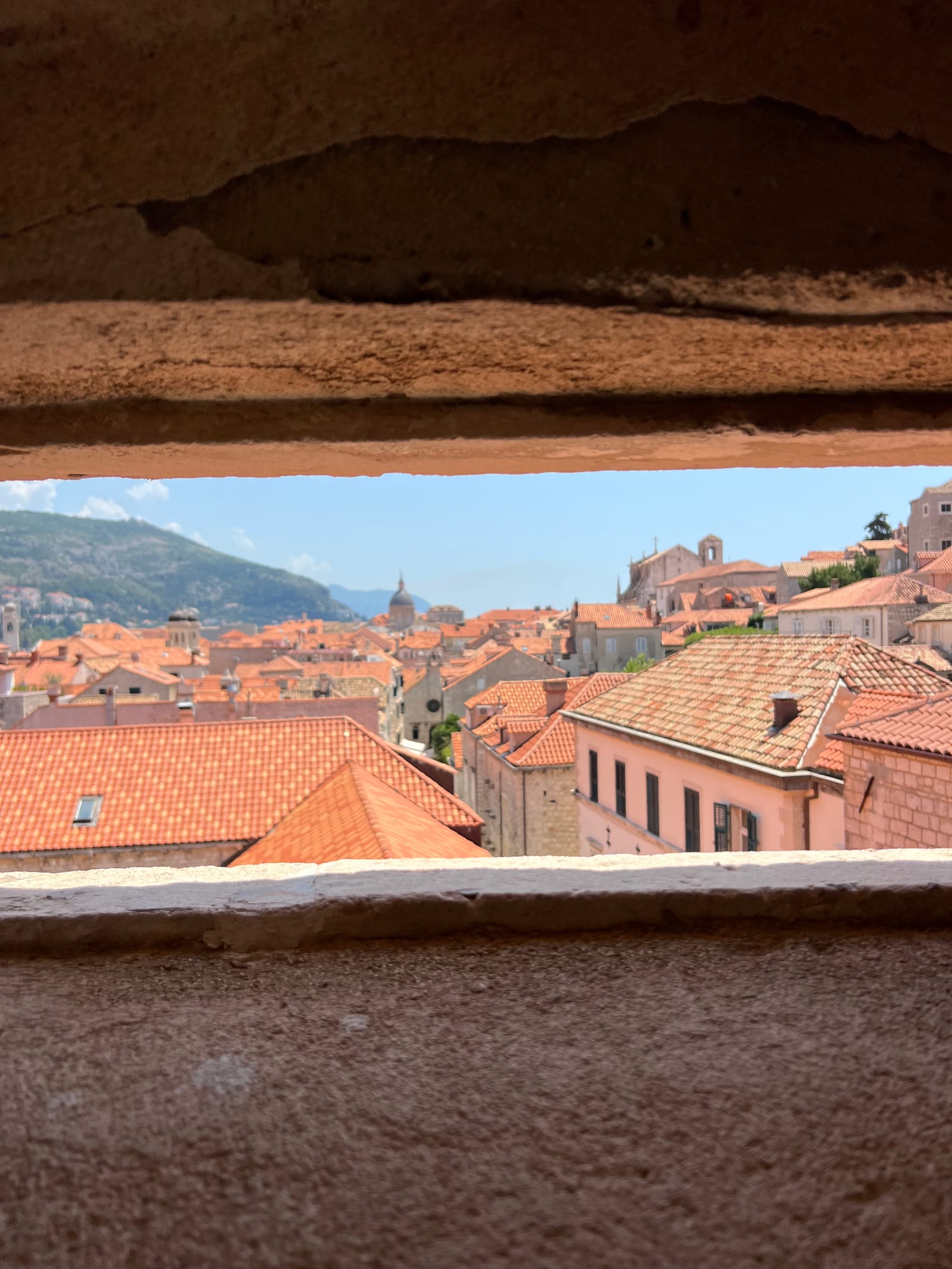
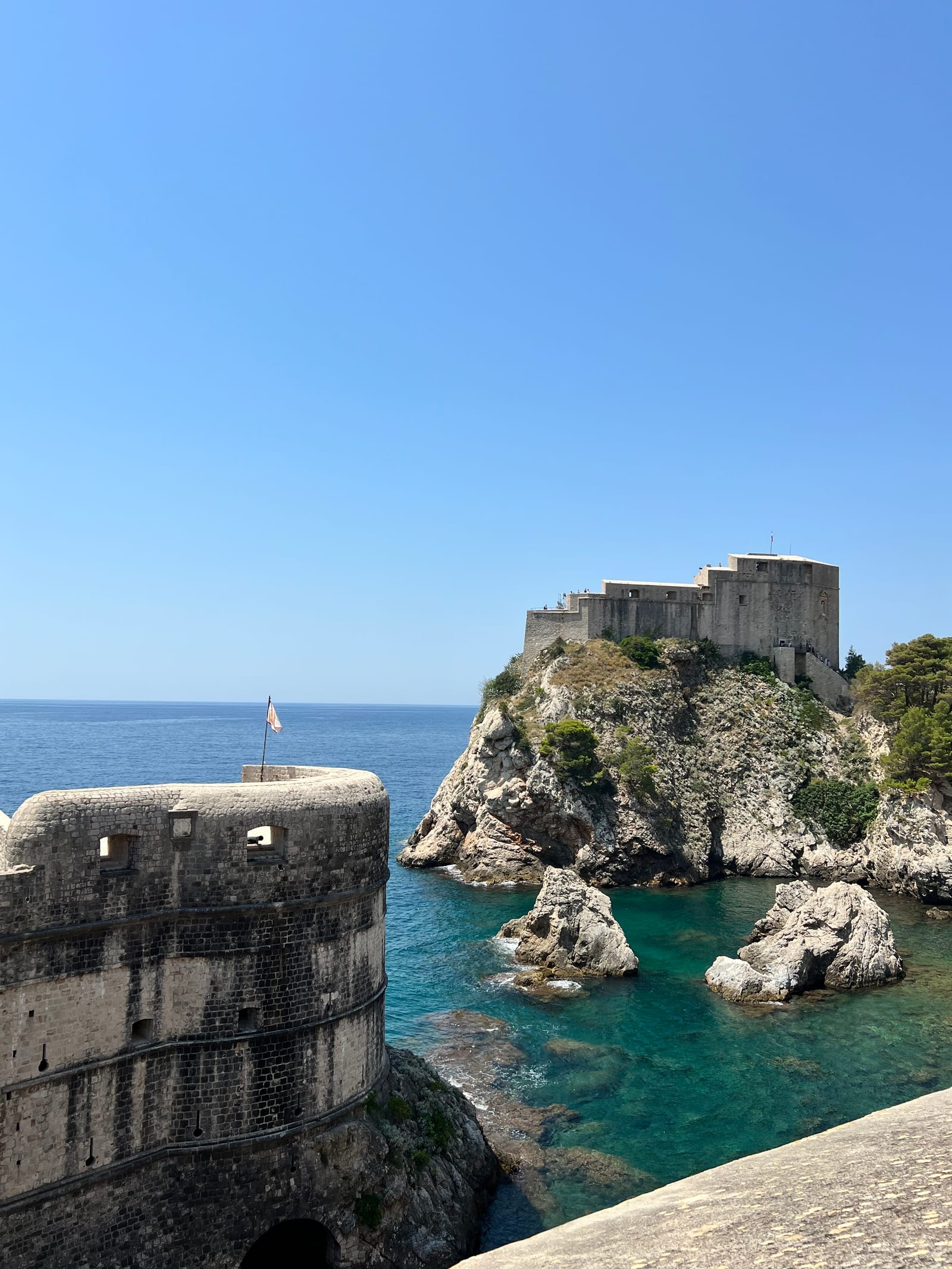
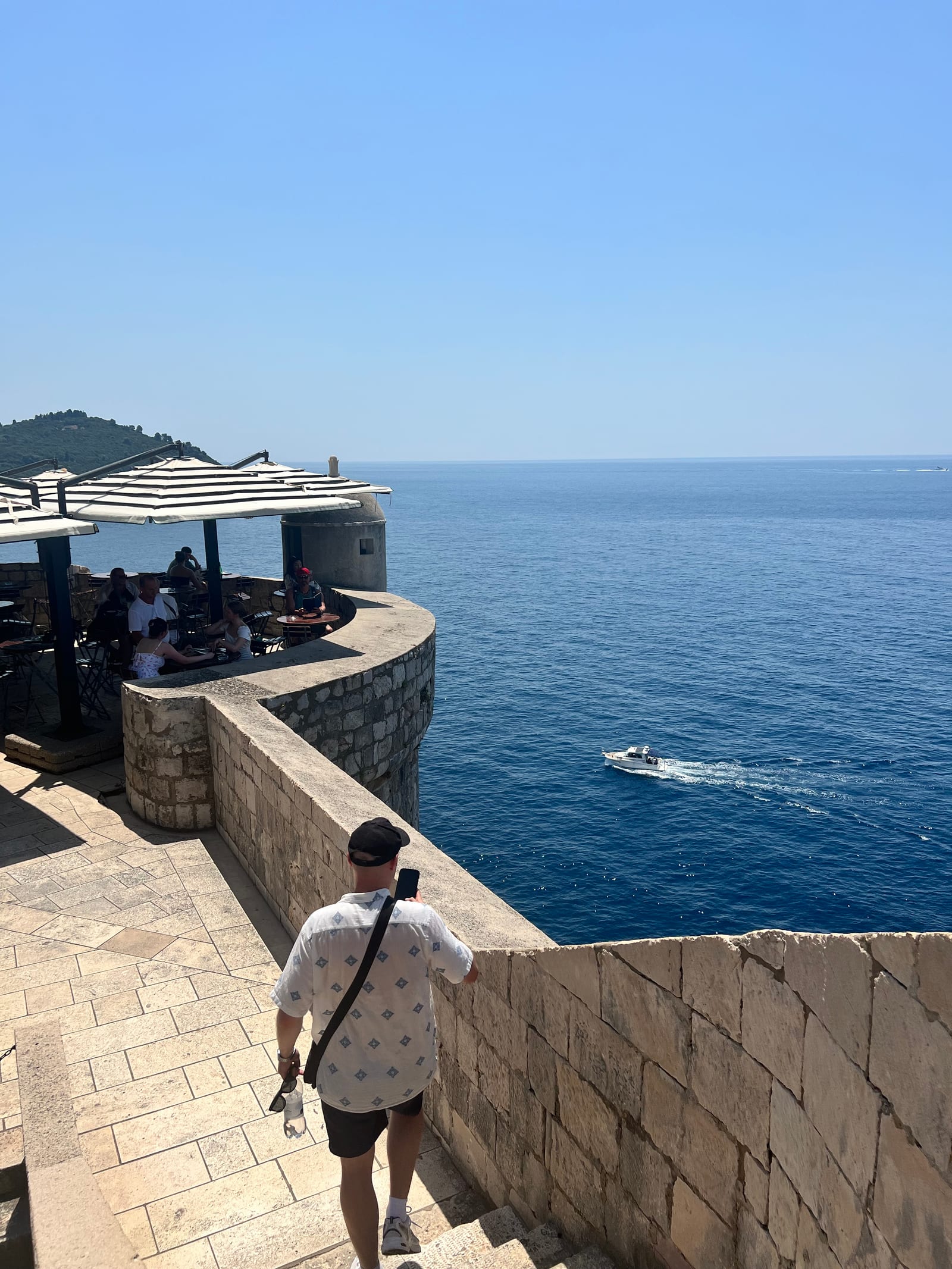
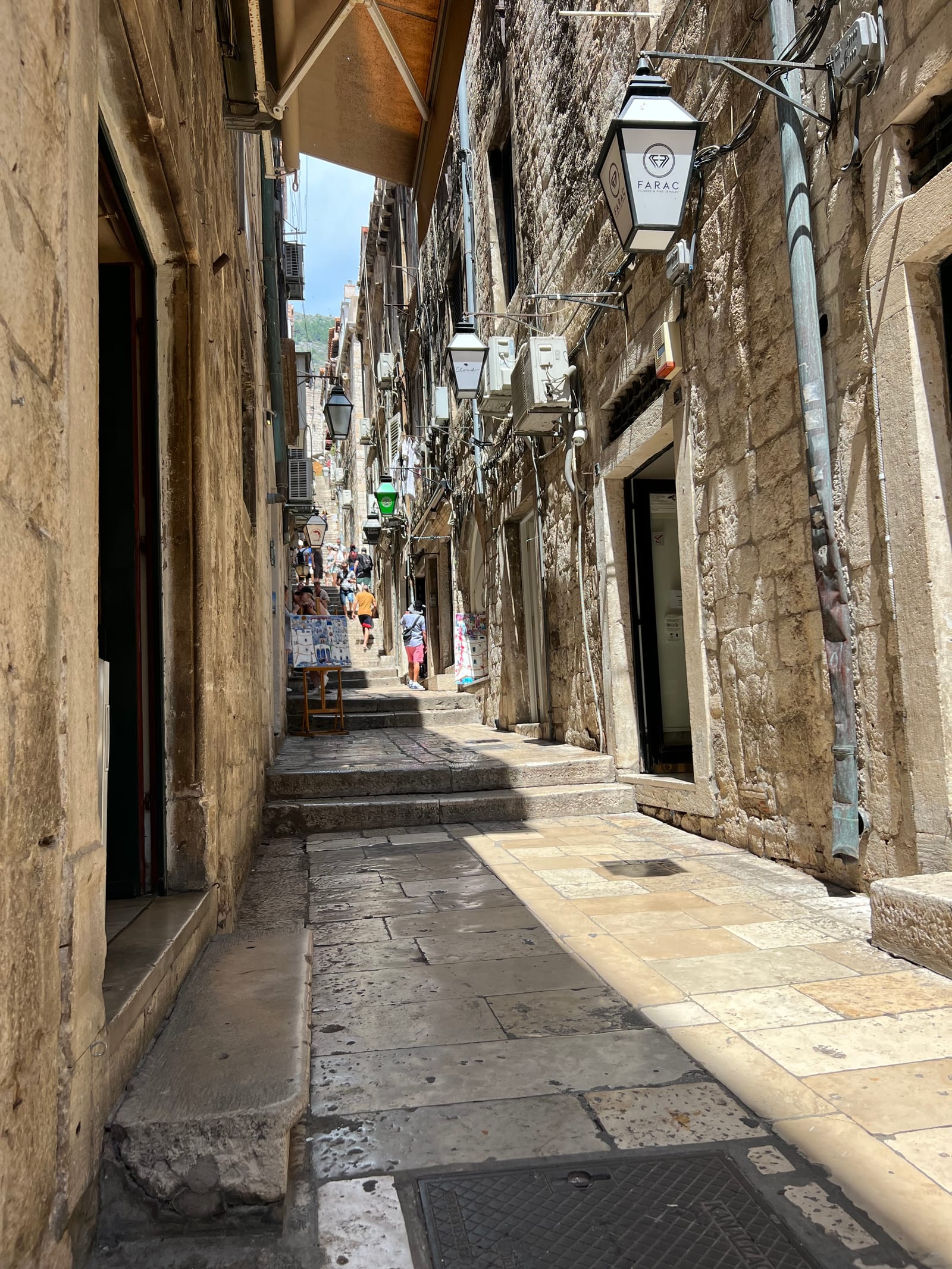
Dubrovnik

Old Town Dubrovnik Self-Guided Walking Route

The route at a glance

  1. 1 Pile Gate (Gradska vrata Pile) start — western entrance to the old town
  2. 2 Onofrio's Large Fountain Immediately inside Pile Gate, on your left
  3. 3 Franciscan Monastery and Old Pharmacy 2 min — follow the wall of the monastery south of the fountain
  4. 4 Stradun (Placa) — mid-point 5 min walk east down the main street
  5. 5 Orlando's Column and the Loggia East end of Stradun — Luža Square
  6. 6 Sponza Palace (Palača Sponza) North side of Luža Square
  7. 7 Rector's Palace (Knežev dvor) 2 min south from Luža Square
  8. 8 Cathedral of the Assumption (Katedrala Uznesenja) 30 seconds south from Rector's Palace
  9. 9 Old Port (Stara luka) 5 min walk south-east — follow signs to the port
  10. 10 Ploče Gate (east exit) 10 min walk north-east from Old Port

Why walk it yourself

Dubrovnik is one of the most guided cities in Europe in season. At 10am on a summer morning, a dozen group tours are in motion simultaneously on the Stradun, each with a flag and a cluster of thirty people following it at the same pace, stopping at the same spots, hearing the same script. The old town is small enough — 1.6 kilometres end to end on this route — that you do not need a guide to navigate it. What you gain by going alone is the freedom to stop when something is worth stopping for, and to keep moving when it isn't.

This route runs from Pile Gate in the west to Ploče Gate in the east, taking in the ten most historically and architecturally significant stops along the way: the two great fountains, the Franciscan Monastery and its famous pharmacy, the civic buildings around Luža Square, the Rector's Palace, the cathedral, and the Old Port. It is 1.6 kilometres of ground-level Dubrovnik — the Stradun plus the detours that make it worth doing.

What this walk gives you

The route is essentially flat. The Stradun itself — about 300 metres of it — is the widest, flattest, most polished stretch. The detours to the Franciscan Monastery, the Rector's Palace, and the Old Port involve short diversions off the main axis, all at street level or close to it.

What the walk does not give you is the elevated view — that requires either the walls circuit or the cable car. The two complement each other: walk the old town at street level first, understand the geography and the buildings, then do the walls and see it from above. In that order, the walls circuit makes considerably more sense.

Ninety minutes is the right budget if you look inside nothing. Add thirty minutes per building you enter. The Franciscan cloister and the pharmacy are worth the time; the Rector's Palace even more so if history interests you. The cathedral is quick. The Old Port can be done in ten minutes or an hour depending on how long you sit on the breakwater.

start — western entrance to the old town

Pile Gate (Gradska vrata Pile)

The Pile Gate is where Dubrovnik begins. The outer arch, built in 1537, is Gothic in style; the inner arch below it dates to 1460. You pass through both in sequence over a stone bridge that once crossed a moat — the defensive logic of a double-gate entry, where the space between the two arches could be sealed and used as a killing ground, is still legible in the architecture.

Above the inner arch, a niche holds a statue of St. Blaise, the patron saint of Dubrovnik — a small figure you will see repeated on buildings, gates, and cornerstones throughout the old town for the next hour and a half. The Republic of Ragusa took its patron seriously: his image was required on every official building, and his intercession was formally invoked in council before major decisions.

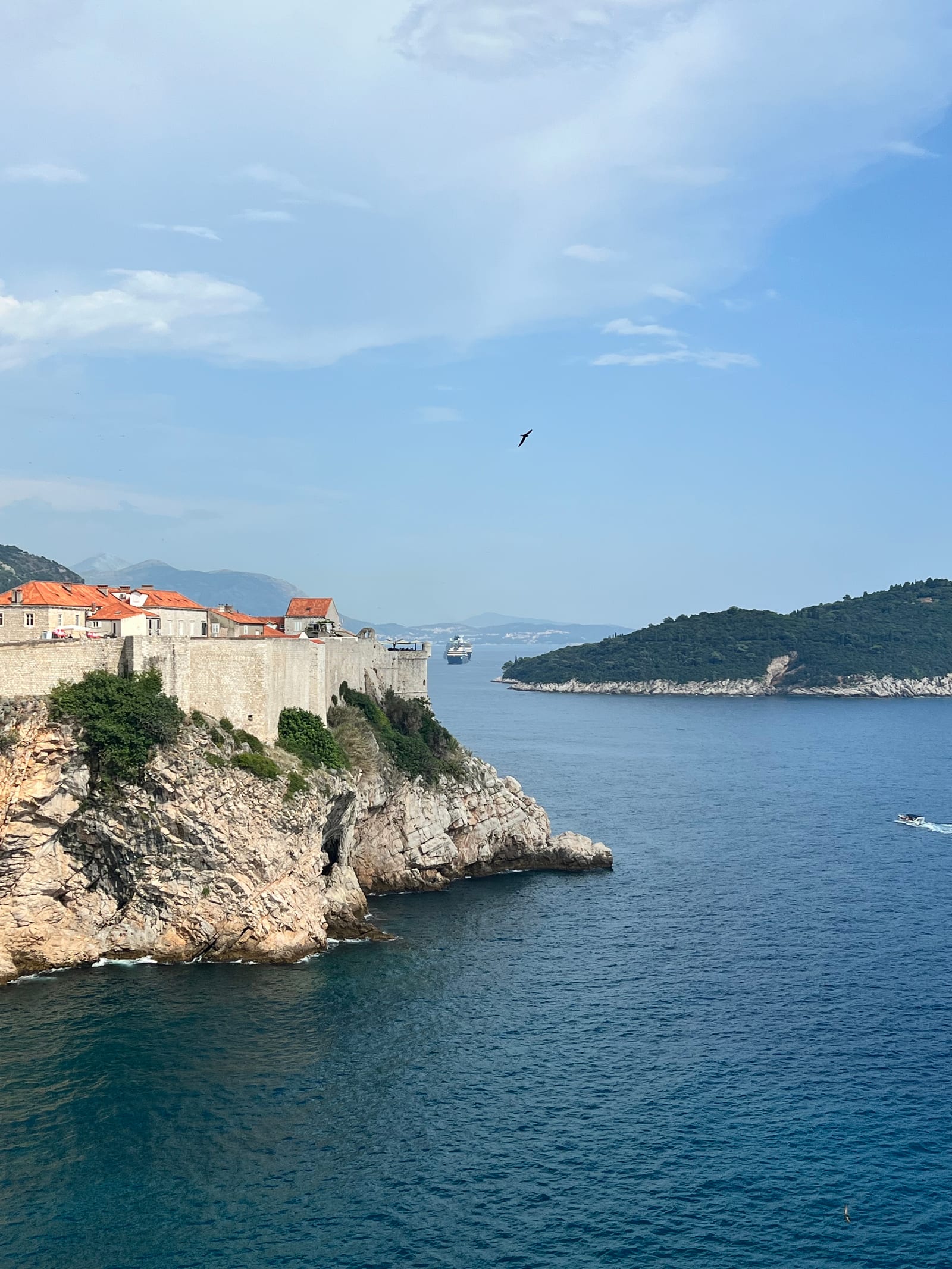
Pass through and stop for a moment before the Stradun opens in front of you. The Onofrio Fountain is on your left. The street ahead runs dead straight for about 300 metres to the far end of the old town. On a summer morning at 8am, with the marble still cool and the light coming from the east, it is one of the finest urban vistas on the Mediterranean.
Immediately inside Pile Gate, on your left

Onofrio's Large Fountain

The large circular fountain just inside Pile Gate was completed in 1438 by the Neapolitan engineer Onofrio della Cava, as part of the same aqueduct project that brought fresh water 12 kilometres from the Dubrovčica river to the city. The fountain served as the terminal distribution point: water flowed in through the aqueduct, collected in the basin, and was drawn off from sixteen carved mask-heads spaced around the drum.

Only the masks survive from the original decoration. The dome above them — which now looks as though it was always part of the fountain — was actually added after the 1667 earthquake, which destroyed the ornamental upper tier. The restored version is simpler than what stood before.

The fountain still runs. Locals fill water bottles from the masks when the taps elsewhere run warm in summer. Travellers who know this do the same. The water is good — it has been good since 1438 — and it is free, which makes it one of the more useful stops on the route.

Pile Gate area — morning light on the west entrance

2 min — follow the wall of the monastery south of the fountain

Franciscan Monastery and Old Pharmacy

The Franciscan Monastery sits immediately south of Onofrio's Fountain, its cloister entrance set slightly back from the Stradun. The order established itself here in the 14th century; the current monastery church was begun in 1317. The 1667 earthquake destroyed most of the upper church structure, but the cloister — a colonnaded courtyard in Romanesque-Gothic style, with double columns and carved capitals — survived largely intact and is the most atmospheric interior in the old town.

Inside the monastery, the old pharmacy is one of the oldest continuously operating apothecaries in Europe. It was founded in 1317 and has operated without significant interruption since — the same year the monastery church was begun, making it one of the founding institutions of the complex. The original stone mortars, ceramic jars, and measuring instruments are on display alongside the active dispensary counter.

Entry to the monastery includes the cloister and the pharmacy museum. Shoulders covered; camera use is permitted in the cloister. In peak season, the cloister fills quickly — arrive before 9am or after 5pm for any sense of quiet.

5 min walk east down the main street

Stradun (Placa) — mid-point

The Stradun — also called Placa — is the spine of the old town. It runs due east from Pile Gate to Luža Square at the far end, about 300 metres in total, and it is the widest street in the old town by a significant margin.

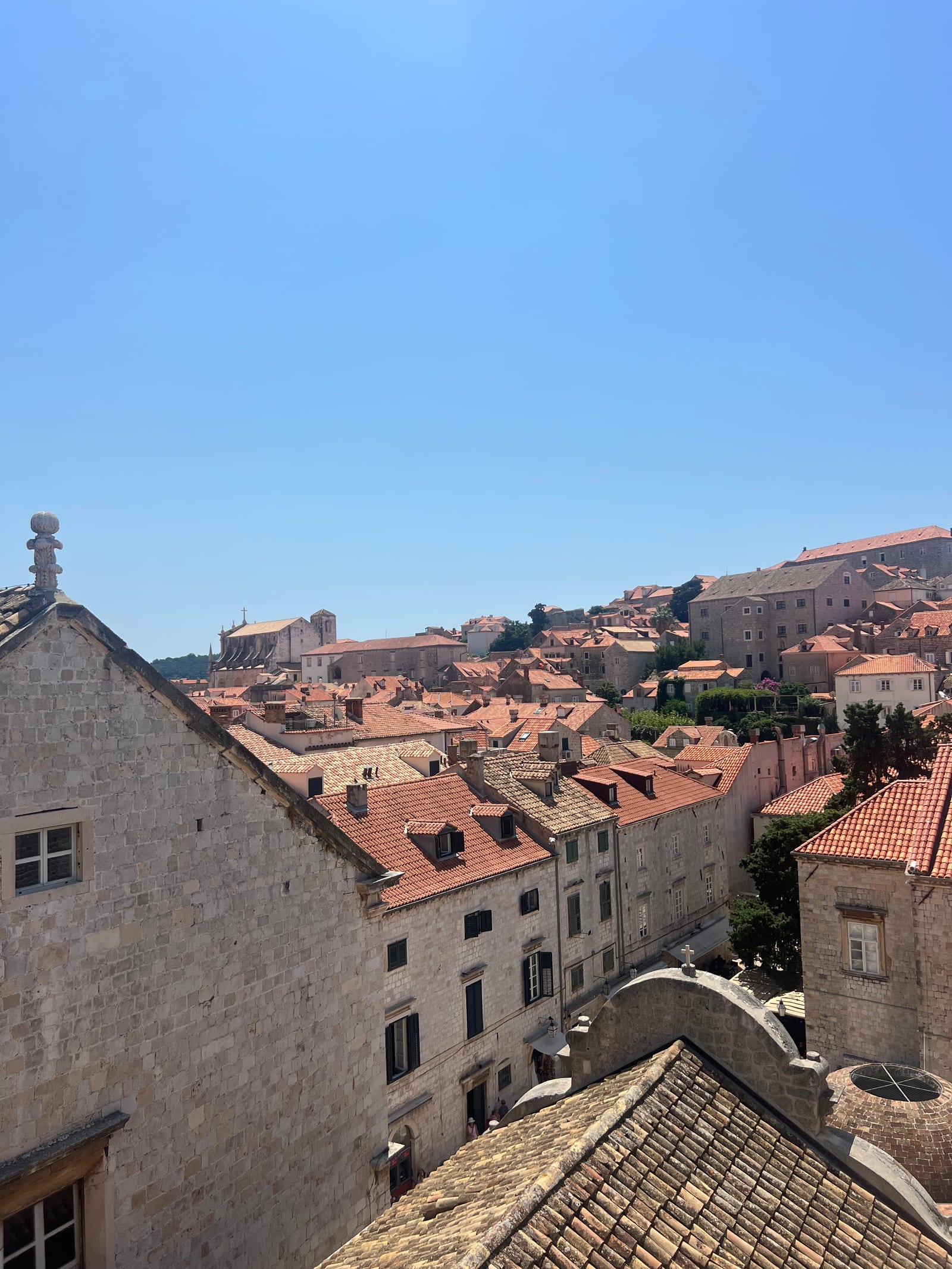
The uniformity of the buildings on both sides is intentional. The 1667 earthquake — which killed over 5,000 people and destroyed most of the medieval city — was followed by a rapid, planned reconstruction. The Republic of Ragusa standardised the building code for the rebuild: all ground floors were to be commercial (shops and workshops), all upper floors residential, all façades to the same height, all doorframes to the same proportions. What you see on either side of the Stradun is the result of that decree, executed in decades after the earthquake and preserved largely intact since.

The marble surface underfoot was laid in the 20th century, replacing an earlier limestone cobble surface. The current marble polishes to a mirror finish in high pedestrian traffic — the shine is not a decorative choice; it is the accumulated result of millions of footsteps.

East end of Stradun — Luža Square

Orlando's Column and the Loggia

Luža Square opens at the eastern end of the Stradun into a slightly wider space flanked by civic buildings. In the centre stands Orlando's Column (Orlandov stup), a Gothic carved figure of a medieval knight erected in 1417. The knight depicted is the legendary Roland — here called Orlando in the Adriatic Italian tradition — a figure associated with Frankish independence from Carolingian authority, which made him a symbolic choice for a city-state that had spent centuries managing its autonomy against much larger neighbours.

The column was also a public noticeboard: proclamations, laws, and sentences were read from its base. The measurement unit of the Ragusan foot (roughly 51.2 cm) was standardised using the length of Orlando's forearm carved on the column — one of the more practical uses of civic sculpture.

Across the square from the column, the Sponza Palace (Palazzo di Dogana) faces you — see the next stop — and the Bell Tower (Gradski zvonik) rises at the corner. The bell tower dates from 1444; the current bell mechanism features two bronze figures known as Maro and Baro who strike the hours. The originals are now in the Sponza Palace; replicas stand on the tower.

Stradun mid-point, looking east
West end of Stradun
West end of Stradun
Center old town
Center old town

Along the Stradun

North side of Luža Square

Sponza Palace (Palača Sponza)

The Sponza Palace is the most significant surviving secular building from before the 1667 earthquake — while the earthquake destroyed most of Ragusa's pre-17th-century civic architecture, Sponza survived intact. It was built between 1516 and 1522, a late flowering of the Gothic-Renaissance transition, designed by Paskoje Miličević (the same architect who rebuilt the Pile Gate in 1471) with a distinctive loggia of Gothic arches on the ground floor and Renaissance windows above.

The building served multiple functions: custom house (dogana), mint, archive, and state treasury at different points in the Republic's history. Today the main hall houses the State Archives — among the best-preserved medieval municipal archives in the world, covering the Republic of Ragusa's public records from the 13th century onward.

The atrium is open and usually free to enter briefly. Inside, a Latin inscription on the wall reads: "Fallere nostra vetant et falli pondera" — "Our weights are forbidden to deceive or to be deceived." The Republic meant it: the same weighing hall where merchants had goods measured was governed by this principle.

2 min south from Luža Square

Rector's Palace (Knežev dvor)

The Rector's Palace stands south of Luža Square, its Gothic-Renaissance loggia fronting a small square that opens toward the cathedral. It was the residence and administrative headquarters of the Rector — the elected head of the Republic of Ragusa — who served one-month terms only and was forbidden to leave the palace during that month except for official functions. The rotation of office and the physical confinement were both designed to prevent any individual from accumulating power.

The building's complex architectural history reflects the Republic's bad luck with explosions: the original Gothic structure was damaged by gunpowder explosions in 1435 and again in 1463, prompting rebuilding and enlargement each time. The current building combines Gothic, Renaissance, and Baroque elements from successive phases of repair, with the elegant arcade of the ground-floor loggia dating from the 15th century and the upper floors largely from later rebuilding.

The palace now operates as the Cultural History Museum — one of the better small civic museums on the Adriatic, with a collection covering the Republic of Ragusa's golden period. The atrium features a 1638 bronze bust of Miho Pracat, the only man the Republic of Ragusa honoured publicly as a patron: a wealthy merchant who left his entire estate to the city.

30 seconds south from Rector's Palace

Cathedral of the Assumption (Katedrala Uznesenja)

The Cathedral of the Assumption occupies a large footprint at the south side of the square between the Rector's Palace and the Bishop's Palace. The current Baroque building was constructed between 1671 and 1713, replacing an earlier Romanesque cathedral that was destroyed in the 1667 earthquake. Tradition holds that the original 12th-century cathedral was partly funded by Richard I of England (Richard the Lionheart), who allegedly donated to Dubrovnik after sheltering here during a storm on his return from the Third Crusade — a tradition Dubrovnik maintained with some civic pride.

Inside, the cathedral holds a significant treasury: relics of St. Blaise including an arm, leg, and skull reliquary (all decorated with Byzantine-era enamel and goldsmithing); a 12th-century icon of the Madonna believed to be after a Raphael composition; and a large polyptych altarpiece. The treasury is separately ticketed and small.

The cathedral exterior — the broad Baroque façade and the dome behind it — is one of the most photographed elements of the south end of the old town. The square in front of it, Bunić Square, is quieter than Luža Square and makes a better lunch stop.

South old town side street

5 min walk south-east — follow signs to the port

Old Port (Stara luka)

The Old Port sits at the south-east corner of the old town, tucked between St. John Fortress and the outer walls. It is smaller than it looks from photographs — the enclosed harbour holds fishing boats, small tour vessels, and the Lokrum Island ferry — but the proportions are nearly perfect: the curved breakwater, the fortress tower, the sea gate through the wall.

The port was the commercial artery of the Republic of Ragusa for centuries. The harbour mouth was controlled by a chain boom attached to St. John Fortress, which could be raised to prevent hostile ships from entering. The Arsenal — where galleys were built and maintained — occupied the northern edge of the harbour; the surviving arch of the Arsenal gate is still visible in the wall.

This is one of the least crowded parts of the old town even in peak season — the Stradun funnels visitors east-west, and the port requires a deliberate southward detour. Sit on the outer breakwater for a few minutes and look back at the walls and the fortress: the view from here, with the fortification reflected in the still harbour water on a calm morning, is better than almost anything on the walls circuit itself.

10 min walk north-east from Old Port

Ploče Gate (east exit)

The Ploče Gate at the eastern end of the old town is the less-visited of the two main gates and the natural end point for this route. Like Pile Gate, it is a double-gate arrangement: an outer Renaissance arch from 1628 and an inner Gothic gate from the 15th century, with the Revelin Fortress standing immediately outside to defend the eastern approach.

Exit through Ploče and you stand on the bridge over the outer moat, facing the road that runs east toward Banje Beach and the coastal road to the airport. The Dominican Monastery is visible immediately to your left from the gate bridge — its bell tower is one of the most distinctive in the old town and the cloister inside rivals the Franciscan one in quality.

From here: return through the gate to catch anything you missed, or continue east to Banje Beach (ten minutes on foot), which gives you the view back to the walls from sea level that most photographs of Dubrovnik are taken from.

Practical tips

Frequently asked questions

How long does the Dubrovnik Old Town walking tour take?

Around 90 minutes at a relaxed pace without going inside any buildings. Add 30–45 minutes for the Franciscan Monastery and old pharmacy; another 30–45 for the Rector's Palace. A full day is not excessive if you go slowly.

Is the Dubrovnik old town walk free?

Yes, the walk itself costs nothing — streets, gates, and squares are all free. The Franciscan Monastery (with old pharmacy), the Cathedral, and the Rector's Palace charge entry fees. Bring cash in euros; card terminals are not always available.

When is the best time to walk Dubrovnik Old Town?

Early morning — before 9am — is the best window in peak season. The Stradun before the cruise ships arrive and before the day-tripper coaches is a different city. Late afternoon after 5pm is the second-best option. July and August between 10am and 3pm are the hardest times to enjoy the walk.

How far is the Dubrovnik Old Town walk?

This route is 1.6 kilometres from Pile Gate to Ploče Gate. The full Stradun (Pile to Luža Square) is about 300 metres — the walk extends off the main street to include the side squares, churches, and the Old Port, which adds the distance.

Is Dubrovnik Old Town accessible for wheelchairs?

The Stradun and Luža Square are accessible. Most side streets, church entrances, and the steps leading down to the Old Port involve some level changes. The Franciscan Monastery cloister and most historic buildings have steps at the entrance. The walk can be done in a modified form staying on the main thoroughfare.

Do you need a guide for Dubrovnik Old Town?

No. The old town is compact, well-signposted, and small enough to navigate confidently on foot. This self-guided route covers the same ground as most group tours at your own pace, with the freedom to linger at what interests you and skip what doesn't.

Walk it with confidence

Walk it with confidence

Get turn-by-turn directions, offline maps, and audio guidance — plus 50+ more curated routes across Europe.