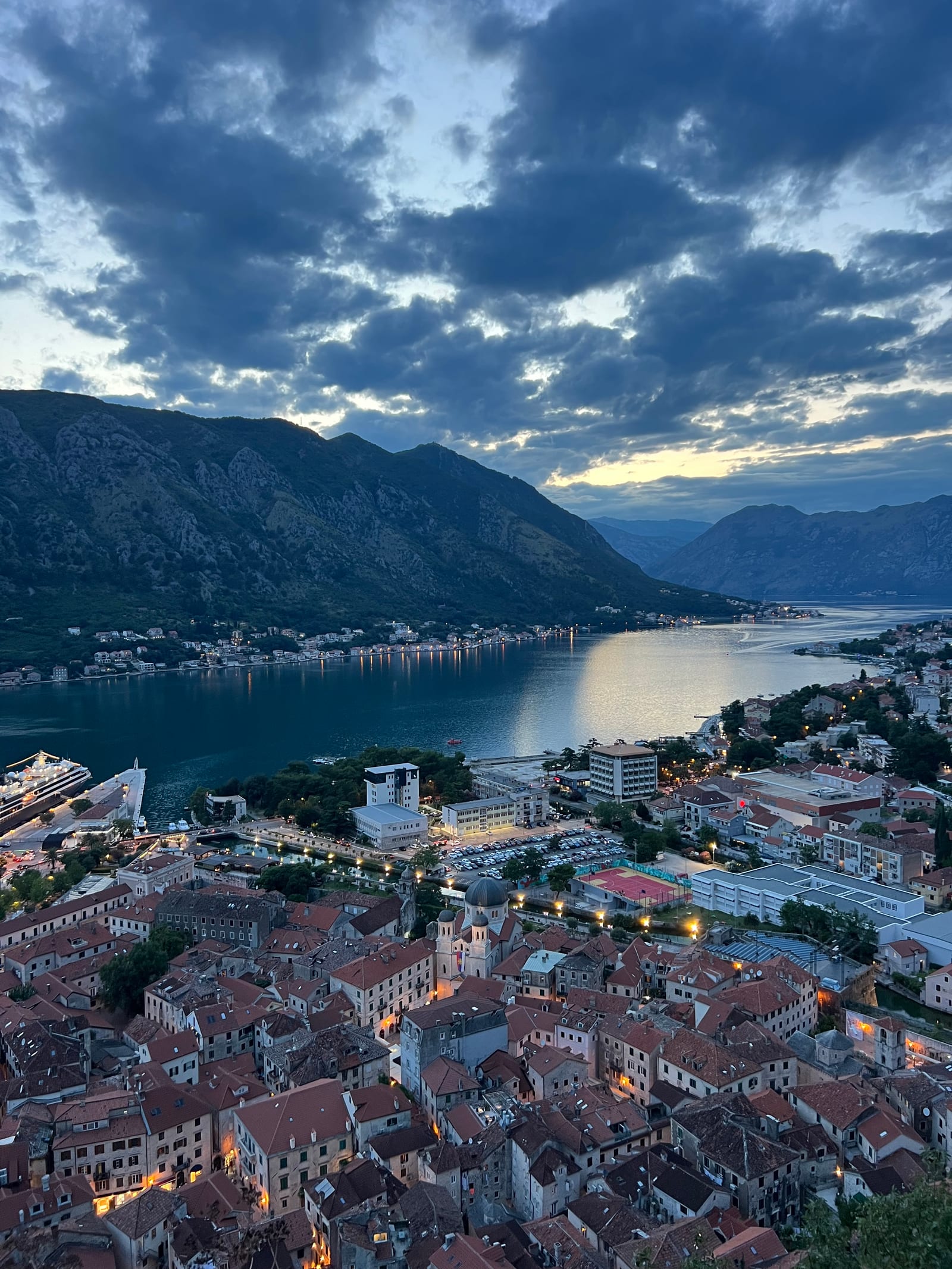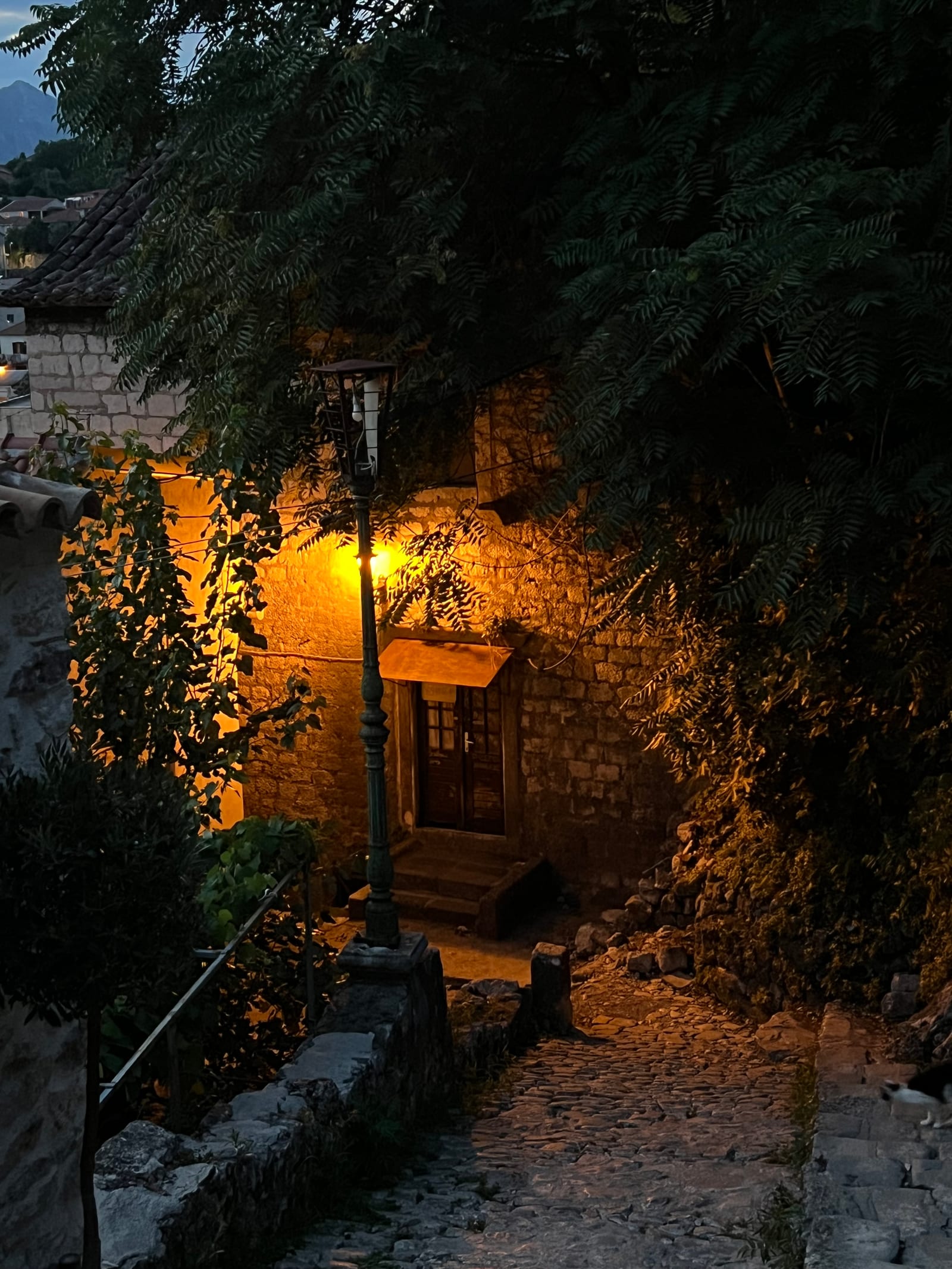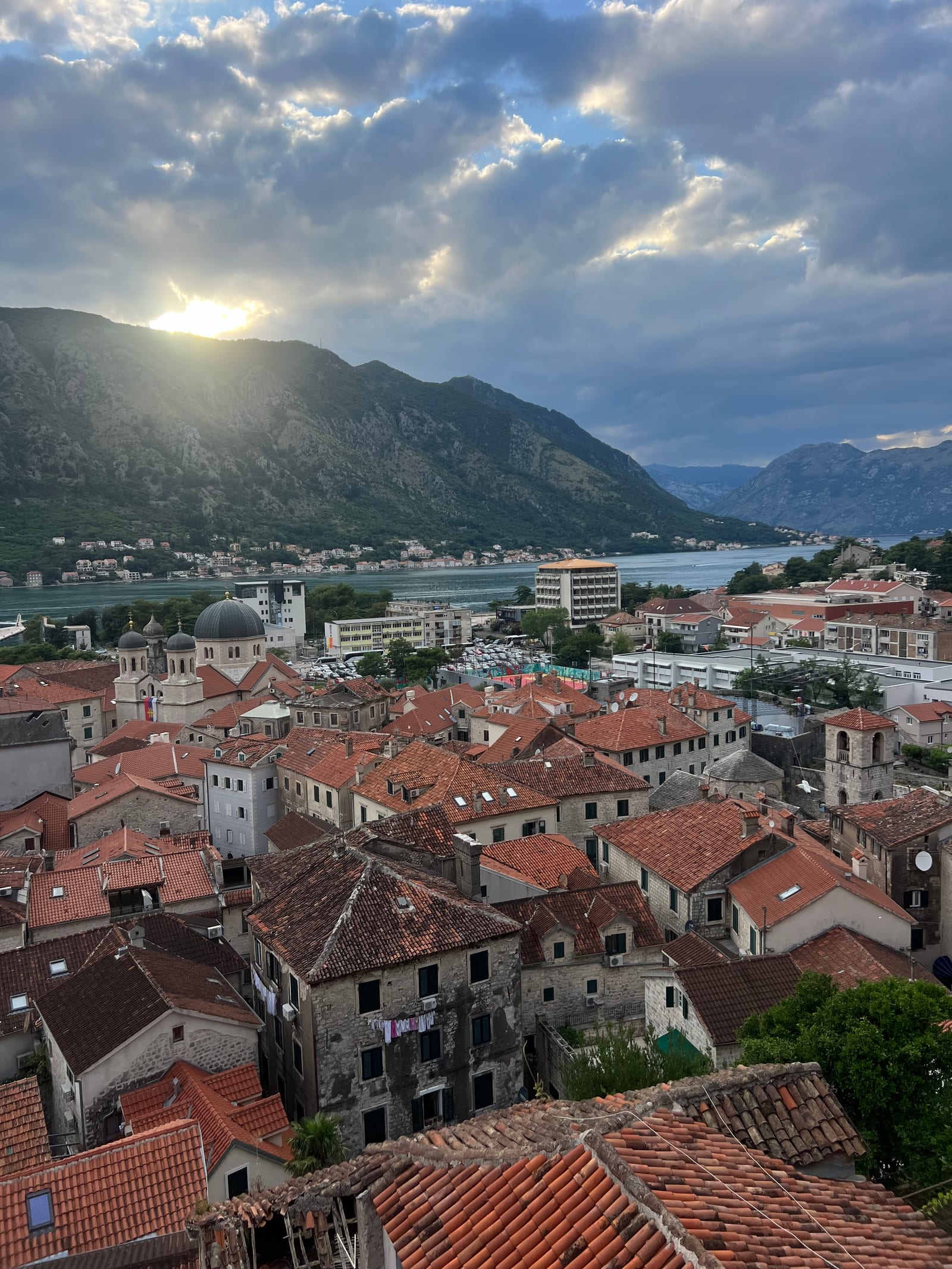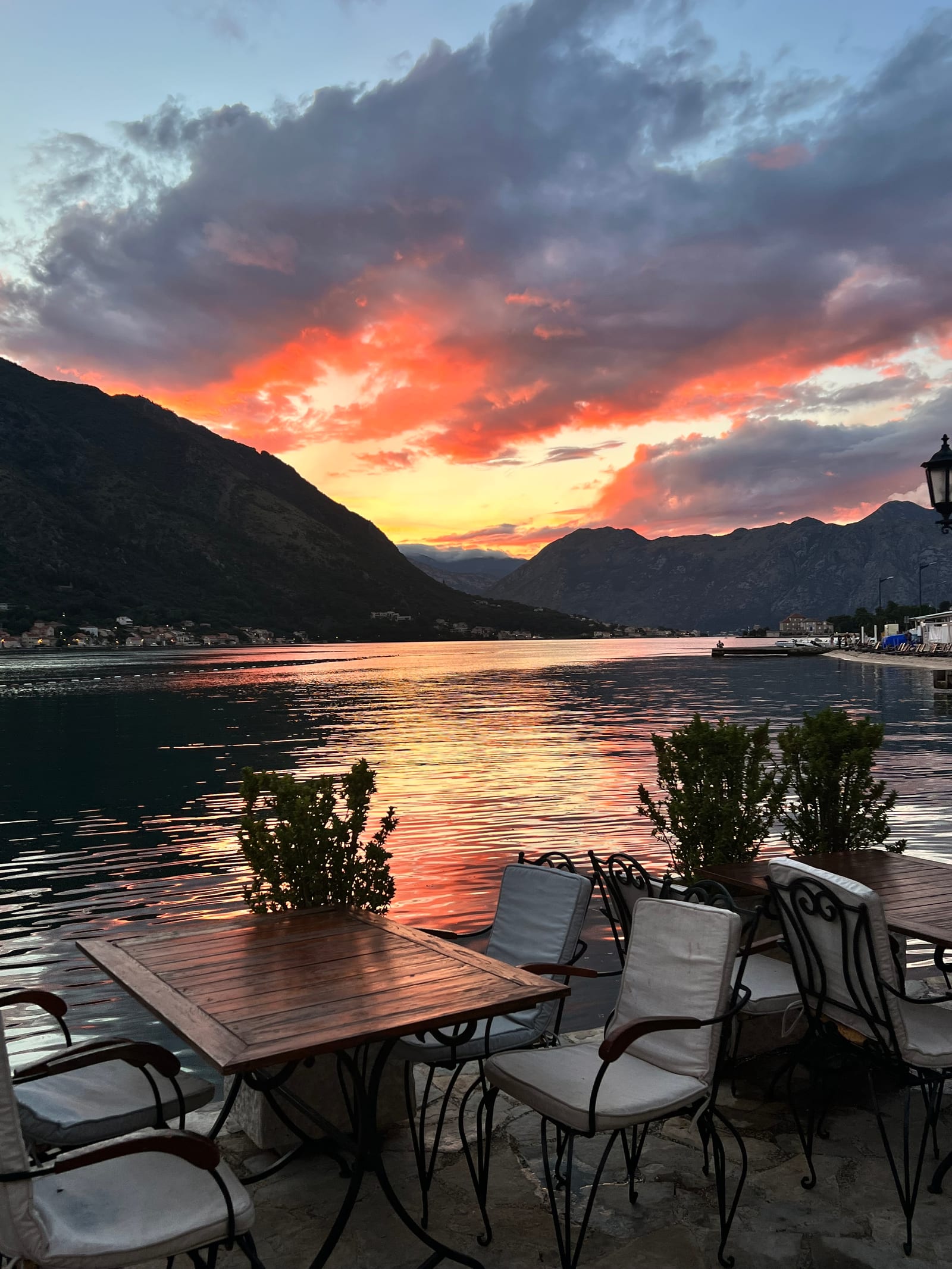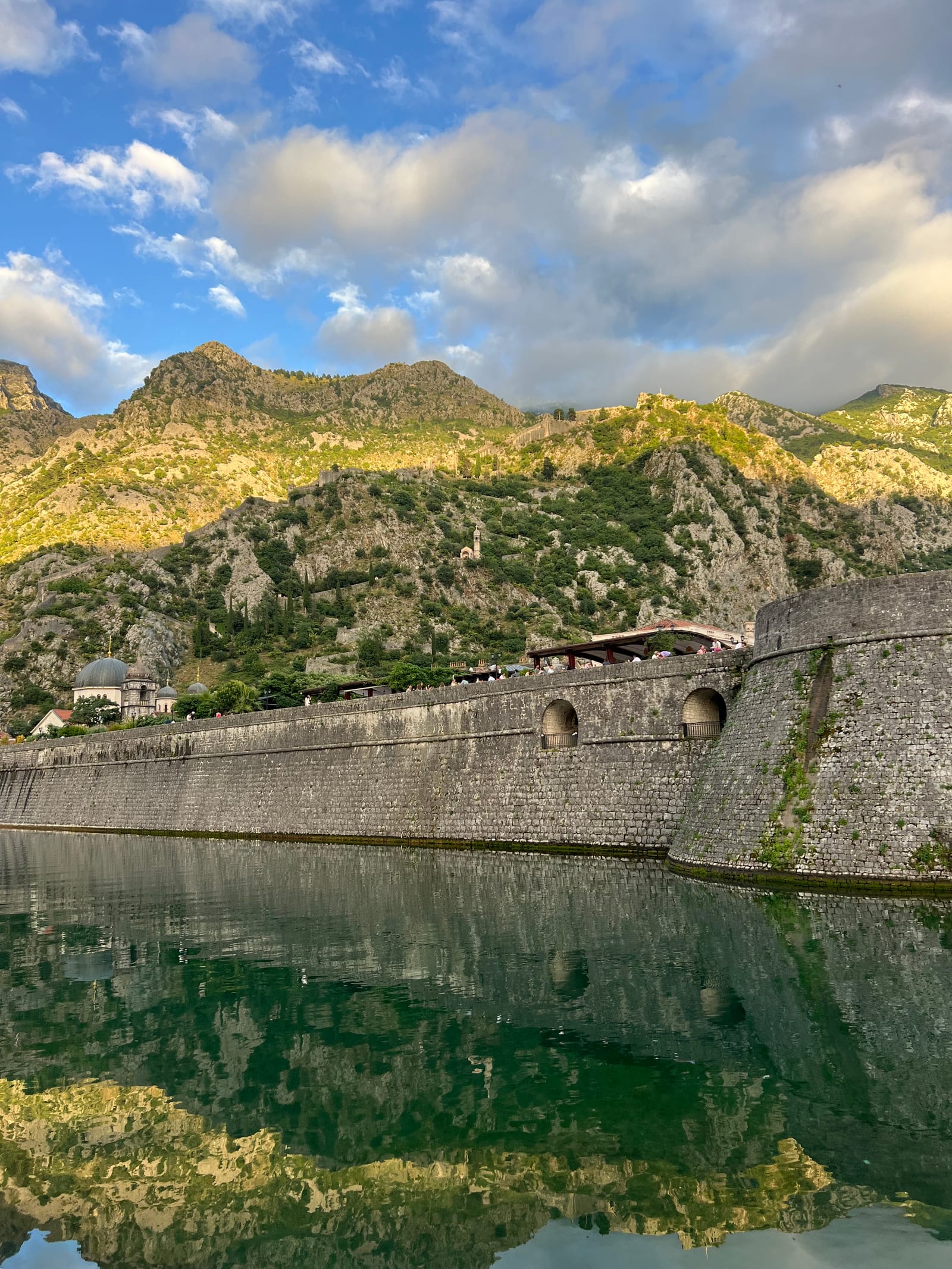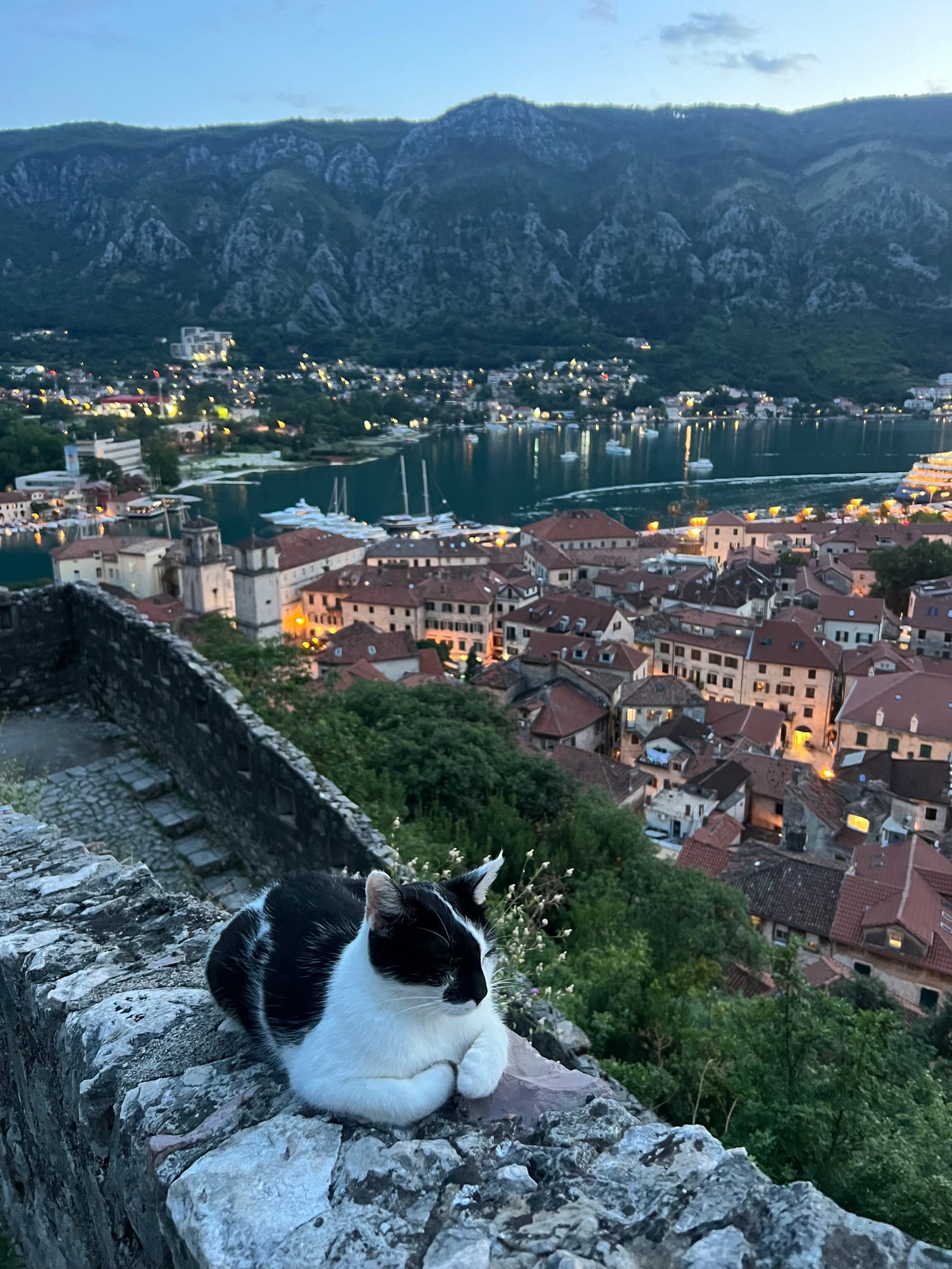
The old town, late afternoon

Kotor

Old Town Kotor Self-Guided Walking Route

The route at a glance

  1. 1 Sea Gate (Vrata od mora)
  2. 2 Square of Arms (Trg od oružja) 1 min walk east through the gate
  3. 3 Clock Tower and Pillar of Shame Across the square — 30 seconds
  4. 4 Maritime Museum (Grgurina Palace) 2 min walk north-east, signposted
  5. 5 Cathedral of Saint Tryphon (Katedrala Svetog Tripuna) 2 min walk south into Trg svetog Tripuna
  6. 6 St. Luke's Square (Trg svetog Luke) 3 min walk north through the alleys
  7. 7 Church of St. Luke (Crkva Sv. Luke) Western side of St. Luke's Square
  8. 8 Church of St. Nicholas (Crkva Sv. Nikole) 30 seconds — same square, to your right
  9. 9 Pjaca od Salate (Salad Square) 3 min walk east through the alleys
  10. 10 Church of St. Mary Collegiate (Crkva Sv. Marije Koleđate) 2 min walk north-west into Trg od drva
  11. 11 North Gate (Vrata od Škurde) 2 min walk north-west to the wall

Why walk it yourself

There are free walking tours that gather every morning by the Sea Gate, and they are perfectly fine — but a guided group moves at one speed, stops where the guide tells it to stop, and spends a third of its time waiting for the slowest member to catch up. Kotor's old town is small enough that you don't need a guide. The entire walled area sits inside a fortification perimeter of about 4.5 kilometres, enclosing a compact warren you can read in an afternoon.

What this walk gives you instead: a 1.8-kilometre loop through eleven of the most rewarding stops inside the walls — Sea Gate in, up through the squares and churches, out at the North Gate — at a pace that lets you actually look at what you're standing in front of.

What this walk gives you

Sea Gate to North Gate: the two ends of the route are also the two ends of Kotor's military history — the Venetian entrance from the bay built in 1555, and the gate raised immediately after Barbarossa's fleet withdrew in 1539. In between: the largest and the quietest squares in the old town, a famously leaning Baroque clock tower, the 12th-century cathedral of Kotor's patron saint, and the small square where a Catholic and an Orthodox altar stood side by side for more than a century and a half.

The route is essentially flat. No climbs, no long staircases — that separates it from the harder walk up to St. John's Fortress, which is a separate route. Suitable for most travellers in normal walking shoes, though uneven cobblestones make it slow going for wheelchairs and small-wheeled strollers. Ninety minutes at a relaxed pace without going inside the cathedral or the museum; closer to two and a half hours with both.

Sea Gate (Vrata od mora)

The Sea Gate was the most heavily defended of Kotor's three entrances because it faced open water. Set into the western wall directly opposite the cruise quay, the thick limestone arch dates from 1555, when Kotor served as a Venetian frontier post guarding the inner reach of the Bay of Kotor.

Look up before walking through. The original Venetian winged-lion relief above the arch was replaced after the Second World War with an inscription marking 21 November 1944 — the day Kotor was liberated from Axis occupation. The carved emblem and a short statement attributed to Tito on territorial independence have stayed in place ever since: mid-20th-century political memory pressed into a 16th-century stone wall.

The gate is also the single busiest point in the old town. By 11am the cruise tide is in full flow and the arch becomes a slow-moving queue. Step through, pause a moment under the deep vault, and emerge into the largest square in town.
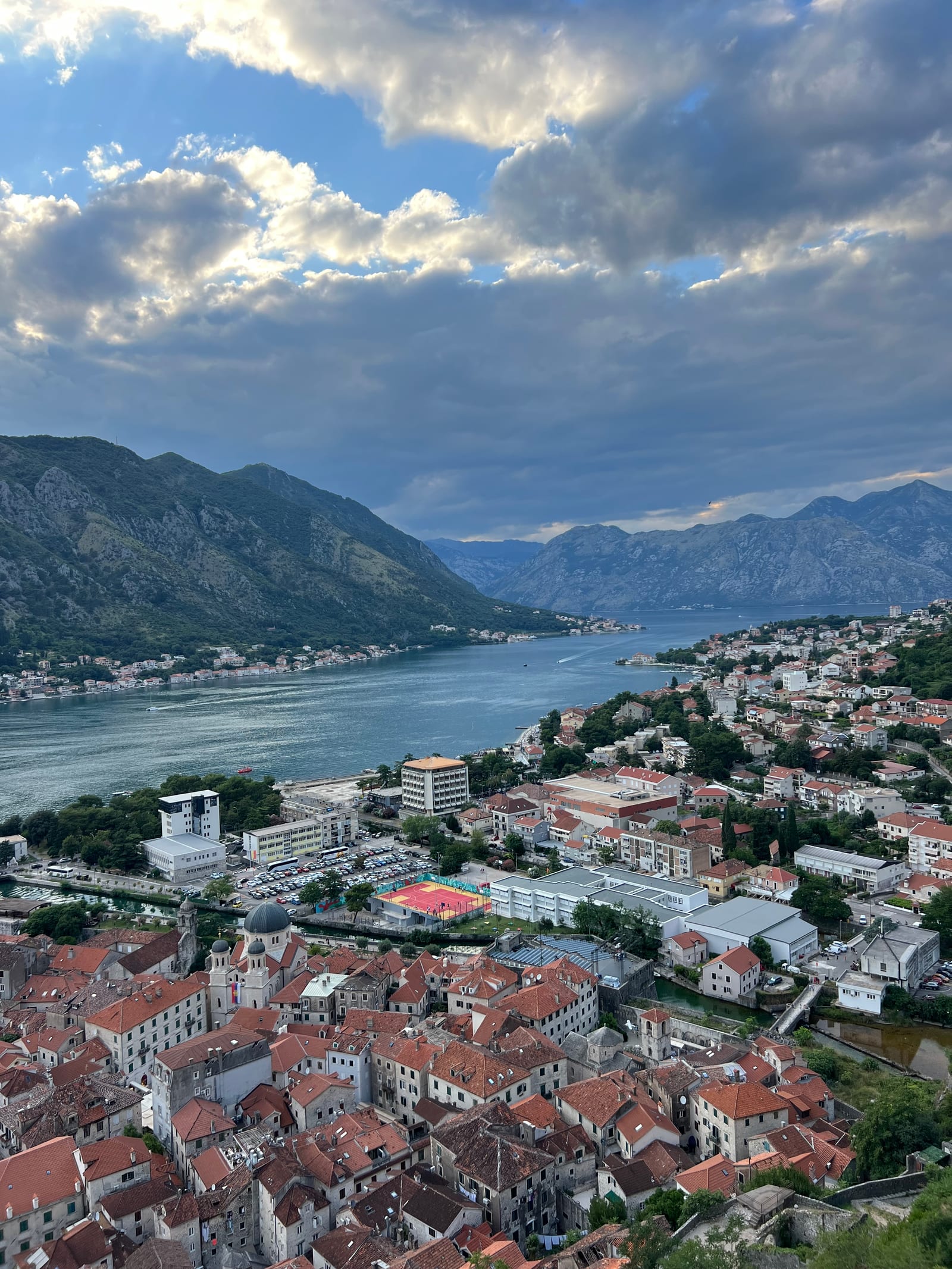
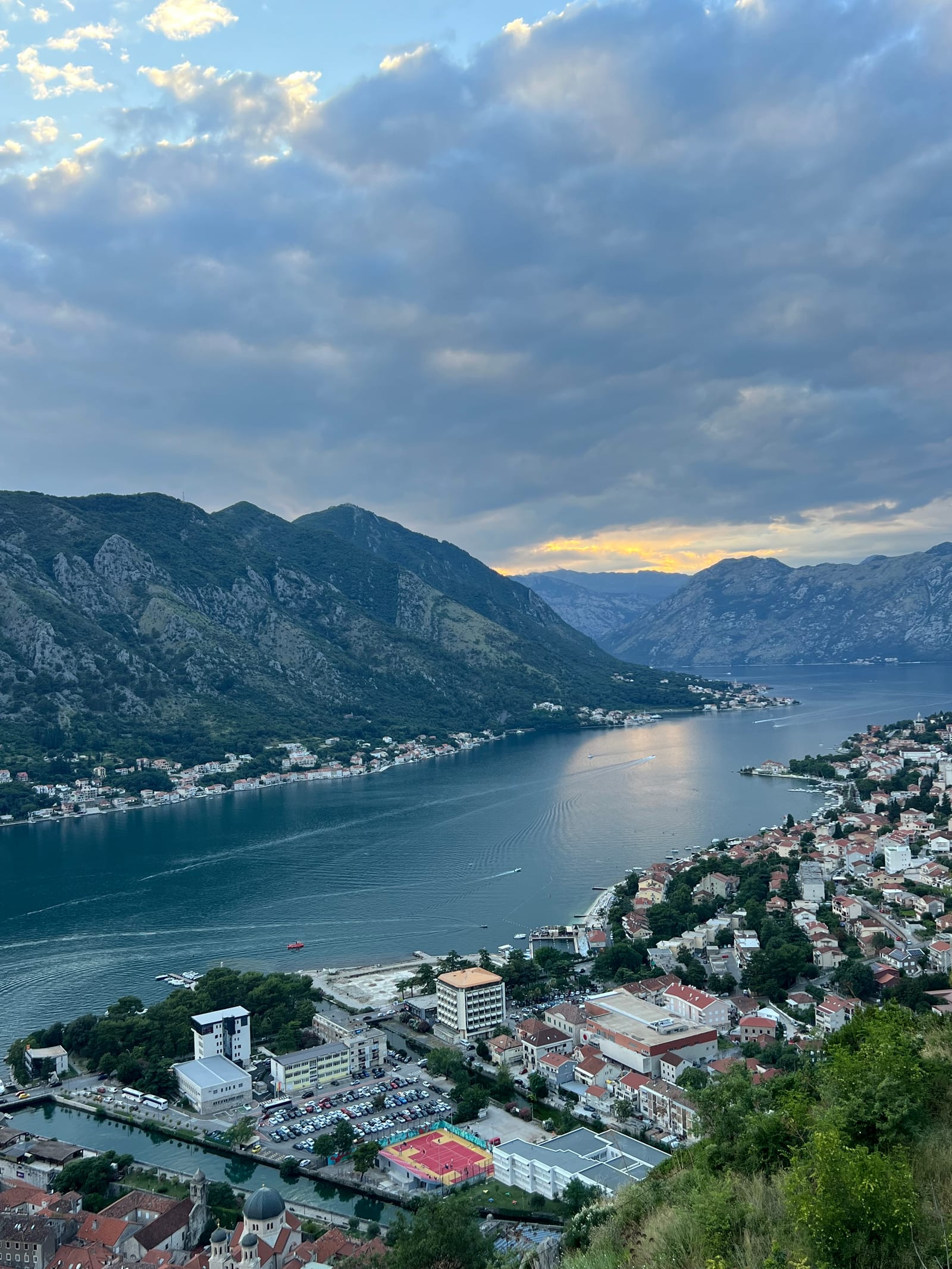
1 min walk east through the gate

Square of Arms (Trg od oružja)

A long, irregular expanse of worn marble — the Square of Arms is both the civic heart of the old town and its main orientation point. Under Venetian rule the surrounding buildings included an arsenal where weapons were manufactured and stored, the Rector's Palace on the western side, and a town guard tower. The square's name still refers to that arsenal function.

Narrow streets branch off in every direction from here into the old town's tight grid. North-east toward the cathedral, north toward St. Luke's Square, north-west toward the North Gate. Every café spills tables into the square, and the people-watching — especially around the Clock Tower — is some of the best in Montenegro.

The buildings around the perimeter were rebuilt after the major earthquakes of 1667 and 1979, but the shape of the square, and the street pattern leading into it, has changed very little since the late Middle Ages.

Across the square — 30 seconds

Clock Tower and Pillar of Shame

The Clock Tower (Sat kula) stands roughly in the centre of the square and is impossible to miss. Built in 1602, late in Kotor's Venetian period, the three-storey stone tower mixes Baroque and Gothic detail in a way typical of the bay's hybrid architectural tradition. The clock face is not original — the mechanism has been replaced more than once — but the stone shell has survived several centuries of earthquakes and sieges.

The tower leans. Look at it from a few steps back and the tilt is obvious: the legacy of the April 1979 Montenegro earthquake, which damaged much of the old town. The foundations were stabilised during repairs, but the lean was deliberately left in place as a reminder.

At the base of the tower, easy to miss if you're looking up, sits a small low pyramidal stone — the Pillar of Shame (Stub srama). A medieval public-shaming post. Offenders convicted of minor crimes were chained to it in full view of the square for the passing crowd to mock or strike. Most travellers walk past it without knowing what it is.

Late light on stone
Late light on stone

2 min walk north-east, signposted

Maritime Museum (Grgurina Palace)

The building itself is the argument for stopping here: an early-18th-century Baroque palace built by the noble Grgurina family, with stone balustraded balconies along the façade and the proportions of a serious Venetian townhouse.

The museum collection grew out of a private collection assembled around 1880 by the Boka Marine — the Brotherhood of Sailors of the Bay of Kotor — and opened to the public in 1900. Between 1949 and 1952 the palace was fully restored to house the museum. Inside: scale models of galleys, brigs, and 19th-century steam vessels; navigational instruments; portraits of Kotor sea-captains; and an ethnographic room covering the bay's maritime golden age from the 16th to the 18th centuries.

Forty-five minutes is plenty if you read most captions; thirty if you skim. Small entry fee, cash in euros. Closed Mondays in winter — check at the door.

2 min walk south into Trg svetog Tripuna

Cathedral of Saint Tryphon (Katedrala Svetog Tripuna)

Consecrated on 19 June 1166 — a date pinned exactly because the dedication is recorded in contemporary documents — the Cathedral of Saint Tryphon is the single most important building in the old town. Built in Romanesque style, the bones of that structure are still legible even after repeated rebuilding. The two flanking bell towers and the broad façade date from the long recovery after the 1667 earthquake, which collapsed much of the original. The most recent restoration ran for fourteen years before finishing in 2000.

Inside, look for the 14th-century frescoes still visible on sections of wall, and especially the stone ciborium above the main altar, carved with scenes from the life of St. Tryphon — Kotor's patron saint, whose silhouette appears on the city's coat of arms. The treasury holds a famous silver reliquary in the shape of a hand and a relief-decorated processional cross.

Entry includes the treasury. Shoulders and knees covered; this is an active cathedral.

3 min walk north through the alleys

St. Luke's Square (Trg svetog Luke)

The network of alleys north of the cathedral can feel disorienting, but you are never more than a couple of minutes from any wall. Come out into St. Luke's Square — a quiet stone-paved space that many returning travellers name as the most atmospheric in Kotor.

Two churches anchor opposite edges: the small, low Church of St. Luke on the western side, and the larger Church of St. Nicholas with its twin bell towers on the north. They sit a few metres apart and are separated by more than seven centuries of history and a complicated story of shared use across faiths — the contrast between them is exactly the point.

Cruise groups rarely route through here, which makes it one of the quietest spots on the loop even in high season. Sit on a worn marble step for a few minutes and let the town breathe before continuing.

Side alley, mid-afternoon
Between the two churches
Steps, shutters, shadow

Mid-route

Western side of St. Luke's Square

Church of St. Luke (Crkva Sv. Luke)

Built in 1195, during the reign of Serbian Grand Prince Stefan Nemanja, by a local noble named Mavro Kazafrangi — the Church of St. Luke is one of the oldest standing buildings in the old town and one of the very few that has survived every major earthquake without substantial rebuilding.

Architecturally it is a hybrid: dome and apse follow Byzantine tradition; the western portal and some decorative detail are Romanesque. Inside, fragments of 12th-century fresco survive on the walls; the iconostasis was painted in the 17th century by Dimitrije Daskal.

Its religious history is equally layered. Built and used as a Catholic church, from 1657 — when Orthodox refugees from the Grbalj valley sought shelter inside Kotor's walls during an Ottoman threat — until 1812, both Catholic and Orthodox altars stood inside simultaneously, the two communities taking turns at services. Today it belongs to the Serbian Orthodox Church. Entry is free; the interior is very small, so step quietly if a service is in progress.

30 seconds — same square, to your right

Church of St. Nicholas (Crkva Sv. Nikole)

A few metres across the square stands the Church of St. Nicholas — much larger than its neighbour, a great deal younger. The current building was constructed between 1902 and 1909 in Serbo-Byzantine style, its two prominent bell towers visible from much of the old town.

An earlier Orthodox church stood on this site from 1810 until Christmas Eve 1896, when it burned down; the present building is its replacement, finished a decade later. The interior is darker than the cathedral and very different in feel: gilded icons, lit candles, frescoed dome. Hat off, shoulders covered — the church is in active use by the local Orthodox community.

Entry is free, and in summer the building usually opens through the day with shorter winter hours. Even from outside, the façade and the towers are one of the strongest visual moments on the route.

3 min walk east through the alleys

Pjaca od Salate (Salad Square)

Almost by accident you come out into Pjaca od Salate — "Salad Square". The name is literal. Medieval and early-modern Kotor was fed by market gardens on the flat ground immediately outside the eastern wall; this square, closest to that wall, was where vegetables and herbs were brought in and sold each morning.

One of the quietest squares in the old town today. A long-established konoba-style restaurant sits at one corner, a smaller second restaurant faces it, and a small shop is tucked between them. Locals still use it as everyday space. Stone stairs at one corner are the start of the steep path climbing to St. John's Fortress — that climb is a separate walk, but it is worth noting where it begins.

The light here in the afternoon is better than the Square of Arms, and the noise drops noticeably. Take your time.

Golden hour on the alleys

2 min walk north-west into Trg od drva

Church of St. Mary Collegiate (Crkva Sv. Marije Koleđate)

Continue north through the alleys and you'll arrive in Trg od drva (Wood Square), with the Church of St. Mary Collegiate facing you. The current building dates from 1221, raised on the site of a much older 6th-century structure — one of the oldest standing churches in Kotor, in the quietest quarter of the old town, well off the cruise-group routes.

The exterior is austere grey stone with a small bell turret. Heavy 20th-century bronze doors, covered in bas-relief panels, mark the entrance. Inside, 14th-century fresco fragments survive on the walls, and a glass reliquary holds the remains of Blessed Osanna of Cattaro (1493–1565), an anchoress and mystic who spent most of her adult life walled into a cell attached to a Kotor church. She is the first woman from the territory of present-day Montenegro to be formally beatified by the Catholic Church; her relics were moved here in 1807.

Opening hours are short and unreliable. If the door is open, step inside briefly; if not, the façade and the quiet square in front are reward enough.

2 min walk north-west to the wall

North Gate (Vrata od Škurde)

The smallest and most discreet of Kotor's three gates was built in 1540, the year after a famous defence. In August 1539 an Ottoman fleet under Admiral Hayreddin Barbarossa — by various accounts, around 70 ships and a large landing force — laid siege to the city, pushing up the Škurda river inlet that runs immediately outside this wall. After four days the fleet withdrew. The new gate, built immediately afterwards, was both a practical replacement and a piece of civic memory.

Stand under the arch and look up. The Renaissance-style pediment carries a relief of a stylised fortress flanked by the winged lion of St. Mark — the symbol of Venice — together with two short Latin inscriptions commemorating the 15 August 1539 victory. Walk through and you cross a three-arch stone bridge over the Škurda; the river runs cold from the mountains directly behind, and in summer locals swim in the pools beneath.

From here: loop back south inside the walls for a final coffee in the Square of Arms, or step out through the gate, turn right along the moat, and find the trailhead for the fortress climb up to St. John's — a separate walk, but it starts right here.

Practical tips

Frequently asked questions

How long does the Old Town Kotor walking tour take?

Around 90 minutes at a relaxed pace. Do it in an hour if you skip interiors, or stretch it to half a day with coffee stops, the Maritime Museum, and the cathedral treasury.

Is the Kotor Old Town walking tour free?

Yes. Streets, gates, and squares cost nothing. The only paid stops are optional: a small entry fee for the Cathedral of St. Tryphon and another for the Maritime Museum. Bring cash in euros — card readers are not always available.

When is the best time to walk Kotor Old Town?

Before 10am, before cruise ships open their gangways, or after 5pm once the day groups have gone. Late spring and early autumn give mild temperatures and quieter squares; July and August are hot and very busy.

Can you walk Kotor Old Town in winter?

Yes — one of the most peaceful times of year. The old town is open year-round; many cafés and a few restaurants stay through January and February. Some smaller churches and the Maritime Museum keep shorter winter hours, so check on the day.

Do you need a guide for Kotor Old Town?

No. The town is small — the walls enclose only about 4.5 km of fortifications around a compact warren of stone streets — and signage is good. A self-guided walk gives you the same history at your own pace, with the freedom to linger or skip.

Is Kotor Old Town accessible for wheelchairs or strollers?

Partially. The streets inside the walls are flat with no significant slopes, but uneven marble cobblestones make small wheels difficult. The Cathedral of St. Tryphon and a few smaller churches have entrance steps. The climb to St. John's Fortress is not accessible.

Walk it with confidence

Walk it with confidence

Get turn-by-turn directions, offline maps, and audio guidance — plus 50+ more curated routes across Europe.