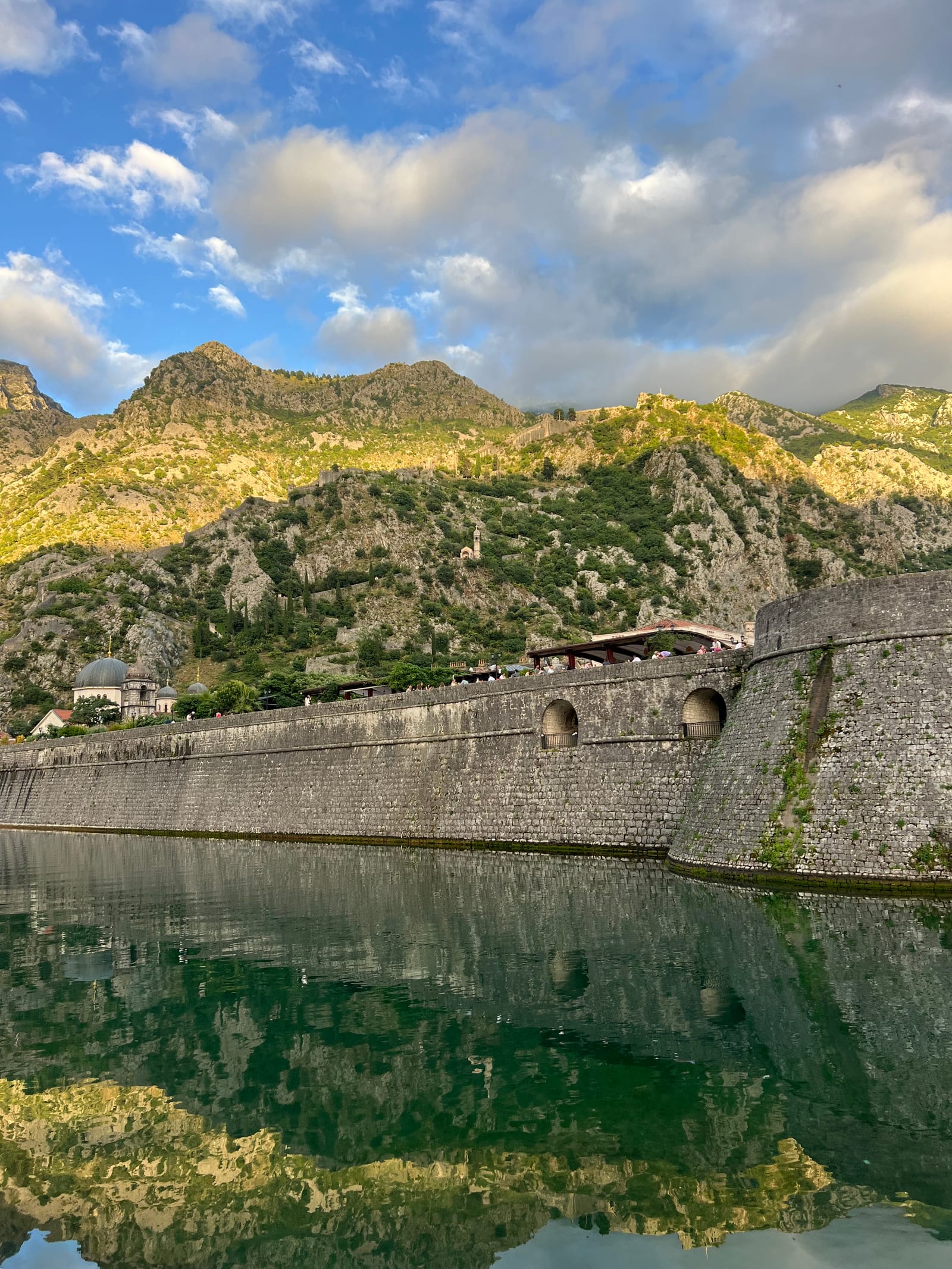
The Sea Gate from the quay

Kotor

Cruise Port to Kotor Old Town — Quick Orientation Walk

The route at a glance

  1. 1 Cruise quay — orientation start — at the ship
  2. 2 Sea Gate (Vrata od mora) 2 min walk from the quay
  3. 3 Square of Arms (Trg od oružja) 30 seconds through the gate
  4. 4 Clock Tower and Pillar of Shame 30 seconds — centre of the square
  5. 5 Cathedral of Saint Tryphon (Katedrala Svetog Tripuna) 2 min walk north-east to Trg svetog Tripuna
  6. 6 St. Luke's Square (Trg svetog Luke) 3 min walk north through the alleys
  7. 7 Church of St. Luke (Crkva Sv. Luke) Western side of the square
  8. 8 Return via Sea Gate to ship 10 min walk south through the alleys to the gate

What a cruise stop in Kotor actually gives you

The ship docks directly opposite the Sea Gate. You do not need a bus, a taxi, or a map to reach the old town. You walk off the gangway, cross the quay, and enter through a 1555 Venetian gate. Kotor is genuinely one of the most accessible port cities on the Adriatic — from ship to walled city in two minutes on foot.

What you do with the time between arrival and departure depends on how long you have. Three hours is the minimum that makes sense: enough for this 8-stop loop through the main squares, the Cathedral of St. Tryphon, and St. Luke's Square — the architectural and historical core of the old town — with time for a coffee and a quiet wander. Six hours opens up the fortress climb or the bay walk toward Muo, both of which require a separate physical commitment but pay off in views that the old town itself does not provide.

This route is designed for the three-hour window. It covers 1.4 kilometres inside the walls in a loose loop: Sea Gate in, Square of Arms, Clock Tower, Cathedral, St. Luke's Square and its two churches, return through the alleys to the gate. Eight stops at a pace that lets you actually look at each one, not photograph and move. No entry fees required except the optional cathedral interior; no booking needed for anything.

The one practical fact that makes the biggest difference: timing. The Square of Arms at 8am and the Square of Arms at 11am are different experiences. Multiple ships docking simultaneously fill the streets between ten and noon with thousands of people; the old town is still there, but you are navigating a crowd rather than a city. If your ship arrives early, go in immediately. If you arrive at peak time, the alleys leading to St. Luke's Square — which cruise groups rarely reach — are still manageable.

Bring cash in euros. Know your departure time before you enter the gate.

start — at the ship

Cruise quay — orientation

Step off the gangway and stop. Look directly ahead: the Sea Gate is in front of you, fifty metres away, set into the base of the old town wall. The wall runs in both directions from the gate, and the mountain behind the old town is visible above the roofline. This is the view that confirms you are in the right place.

Orient yourself before entering. The Sea Gate is the main entrance; from here every stop on this route is within a five-minute walk. The old town walls enclose everything — if you stay inside those walls, you can explore freely and find your way back without a map. The gate back to the ship is always marked by the exit to the waterfront.

Note the all-ships schedule posted at the pier. Know your departure time before you go in — and set an alarm. The old town is engaging enough to absorb a full afternoon.
2 min walk from the quay

Sea Gate (Vrata od mora)

The Sea Gate was Kotor's main entrance from the bay — the heavily defended arch where goods, soldiers, and travellers arrived by ship. The limestone arch dates from 1555, late in Kotor's period as a Venetian frontier post. It faced open water then; the quay and reclaimed land in front of it are modern additions.

Look up before you pass through. The original Venetian winged-lion relief above the arch was replaced after the Second World War with an inscription marking 21 November 1944 — the day of Kotor's liberation from Axis occupation — along with a short statement attributed to Tito. Eight centuries of Venetian stone, rewritten in the mid-20th century.

This is the busiest point in the old town during cruise hours. At 11am, when multiple ships have opened their gangways, the arch becomes a slow-moving queue. At 8am, before the first groups arrive, you walk through alone. That difference in timing is measurable in your experience of everything that follows.

Sea Gate — entry into the old town

30 seconds through the gate

Square of Arms (Trg od oružja)

Emerge from the gate into the Square of Arms — the largest square in the old town and the main orientation point. The name comes from the Venetian arsenal that stood here: weapons manufactured and stored for the garrison. The café tables, tourist shops, and cruise groups are additions; the shape of the square has changed very little since the late Middle Ages.

Get your bearings. North-east leads to the cathedral. North leads to St. Luke's Square. The Clock Tower stands in the centre. Every street that branches off from here loops back eventually — you cannot get permanently lost from this point.

If you want a coffee, the cafés here are reliable and fast. In three hours, one coffee stop is easily absorbed. If you are on a tighter schedule, save it for the return.

30 seconds — centre of the square

Clock Tower and Pillar of Shame

The Clock Tower (Sat kula) was built in 1602 and is one of the most recognisable structures in the square. The three-storey stone tower tilts noticeably — the legacy of the April 1979 earthquake that damaged much of the old town. The lean was deliberately left after repairs as a reminder of the damage.

At the base of the tower, at ground level, sits a low pyramidal stone: the Pillar of Shame (Stub srama). A medieval public-shaming post where convicted offenders were chained for the passing crowd to observe and mock. Most visitors walk past it without realising what it is. Look down as you pass.

This pair — the leaning tower built in 1602, the punishment stone set centuries earlier — is the compressed history of the Square of Arms. Two minutes to observe properly; impossible to miss if you stop.

2 min walk north-east to Trg svetog Tripuna

Cathedral of Saint Tryphon (Katedrala Svetog Tripuna)

Consecrated on 19 June 1166, the Cathedral of St. Tryphon is the most important building in the old town and the single stop on this route that is worth going inside. Romanesque in its bones, the cathedral has been rebuilt several times after earthquakes — most significantly after 1667, when the twin bell towers and façade were reconstructed in their current form. The last major restoration completed in 2000.

If you have 30 minutes to spare: go in. Look for the 14th-century fresco fragments on the walls and the carved stone ciborium above the main altar — the canopy carved with scenes from the life of St. Tryphon, Kotor's patron saint. The treasury holds a silver reliquary and a decorated processional cross. Small entry fee, cash preferred, shoulders and knees covered.

If you are on a tighter schedule: the façade and the square in front of it are still worth five minutes. The building reads well from outside.

3 min walk north through the alleys

St. Luke's Square (Trg svetog Luke)

The network of alleys between the cathedral and St. Luke's Square is the most atmospheric section of the old town — narrow, covered, genuinely quiet even in high season. Follow the streets north through the alleys until the path opens into a stone-paved square flanked by two churches.

Many visitors who have been to Kotor multiple times name this as their favourite square — quieter than the Square of Arms, less visited by cruise groups, and framed by two buildings that tell the most complicated religious story in town.

Take a minute here before entering either church.

South end of the old town, near the return path

Western side of the square

Church of St. Luke (Crkva Sv. Luke)

The Church of St. Luke was built in 1195, by a local noble named Mavro Kazafrangi, during the reign of Serbian Grand Prince Stefan Nemanja. It is one of the oldest standing buildings in the old town and one of the few that survived every major earthquake without substantial rebuilding. Architecturally hybrid: dome and apse follow Byzantine tradition; the portal is Romanesque.

Its most unusual feature is its shared religious history. From 1657 to 1812 — more than a century and a half — a Catholic and an Orthodox altar stood simultaneously inside the same building, the two communities taking turns at services. The arrangement began when Orthodox refugees from the Grbalj valley took shelter inside the walls during an Ottoman threat. Today the church belongs to the Serbian Orthodox Church. Entry is free; the interior is small.

Two minutes inside gives you the iconostasis and the fresco fragments. Worth it.

10 min walk south through the alleys to the gate

Return via Sea Gate to ship

From St. Luke's Square the return to the Sea Gate takes ten minutes through the alleys heading south. The route passes through the Square of Arms again — stop for an ATM withdrawal here if you need cash — and exits through the Sea Gate back to the quay.

If time remains: the area around Pjaca od Salate (Salad Square), two minutes east of the cathedral, is quieter and less visited than the main squares. The Maritime Museum is a two-minute walk north-east from the Square of Arms and worth thirty to forty-five minutes if your schedule allows. The trailhead for the fortress climb starts near the north-east corner of the old town — visible from Pjaca od Salate — but requires a separate two-to-three-hour commitment.

Return to the quay, find your ship. The old town walls are visible from anywhere in the bay; once you are back at the waterfront the orientation is immediate.

Practical tips

Frequently asked questions

How far is the Kotor cruise port from the old town?

The cruise quay is directly opposite the Sea Gate — the main entrance to the old town. The walk from the ship to the gate takes under 2 minutes on foot. There is no transport needed; you step off the gangway and the old town walls are immediately in front of you.

What can I see in Kotor in 3 hours on a cruise stop?

Three hours is a comfortable budget for this 8-stop loop: Sea Gate, Square of Arms, Clock Tower, Cathedral of St. Tryphon (exterior and a brief interior), St. Luke's Square, both churches there, and a return through the alleys. Add a coffee stop and you fill the time well. The Maritime Museum takes an additional 30–45 minutes if you want it. Three hours does not allow for the fortress climb.

What can I do in Kotor in 6 hours from a cruise ship?

Six hours is enough for the full old town loop and the St. John Fortress climb. Do the old town first, return to the quay briefly for water and snacks, then tackle the fortress. The climb takes 2.5 to 3 hours round trip. Alternatively, six hours covers the old town loop, a museum, lunch, and a walk along the bay toward Muo — a more relaxed programme with no hard climbing.

Is there an ATM near the Kotor cruise port?

Yes. Several banks with ATMs are located in the streets running north from the Square of Arms, inside the old town walls. There are also exchange offices near the gate. Withdraw cash early in the day — the machines near the quay can run low during peak cruise arrivals when multiple ships dock simultaneously.

Do I need a guide for the Kotor old town from the cruise ship?

No. The old town is small enough to navigate without a guide — the walls are the boundary and every street leads somewhere findable. Organised cruise tours add little over this self-guided route, and they move at the pace of the slowest person in the group. The main advantage of a guide is local history knowledge; this route provides that in text form at each stop.

Walk it with confidence

Walk it with confidence

Get turn-by-turn directions, offline maps, and audio guidance — plus 50+ more curated routes across Europe.